Surf AI Raises $57M to Operationalize Enterprise Security
Surf AI launches with $57M in AI funding to help enterprises close security gaps using agentic AI. See how it transforms security operations.
TL;DR
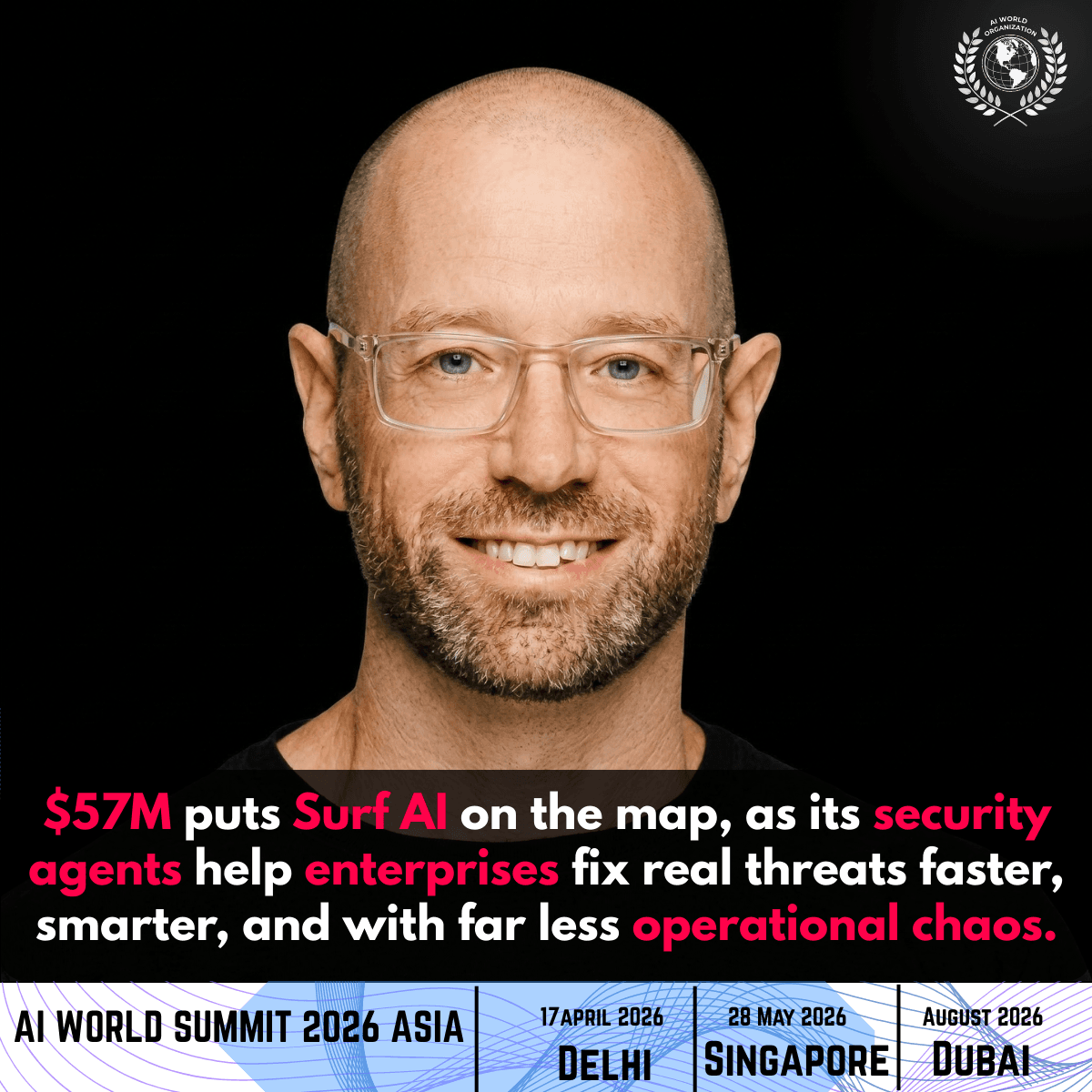
Surf AI, a New York-based cybersecurity startup, has launched publicly with $57 million in AI funding led by Accel. The platform uses AI agents to help enterprise security teams cut through alert overload, fix real risks fast, and stay in control — all without drowning their analysts. Early clients have already recovered nearly $1M in wasted SaaS spend and disabled thousands of dormant accounts posing live security threats.
Surf AI Raises $57 Million to Redefine How Enterprises Tackle Cybersecurity at Scale
The cybersecurity world received a major signal this week as Surf AI, a New York-based agentic operations platform built specifically for modern enterprise security teams, officially announced its public launch alongside a $57 million funding round. This landmark AI funding news comes at a time when the global business community is grappling with an ever-escalating wave of cyber threats — threats that are growing faster, smarter, and more destructive than anything organisations have had to manage before. Surf AI's entry into the market is not just another startup launch. It is, by all accounts, a direct and deliberate response to a structural problem that has plagued enterprise security operations for years: the dangerous gap between identifying risk and actually doing something about it.
The funding round was led by Accel, one of the most recognised venture capital firms in the global technology space, with meaningful participation from Cyberstarts and Boldstart Ventures — both of whom had already backed Surf AI at its seed stage, a testament to the conviction investors have placed in this team from day one. The capital will be channelled toward accelerating product development, expanding the engineering and security leadership teams across the United States and Israel, and scaling enterprise adoption across global markets. For anyone tracking AI funding news in the cybersecurity domain, this round stands out not just for its size but for the calibre of institutional backing it has attracted.
The Founding Team and the Problem They Set Out to Solve
Surf AI was founded in 2024 by a group of deeply experienced leaders from the Israeli cybersecurity ecosystem — a region widely acknowledged as one of the most fertile grounds for world-class security talent and innovation. The founding team includes Yair Grindlinger, who serves as CEO and Co-Founder, along with Elad Horn, Roie Cohen Duwek, Avner Gideoni, and Brenton Gumucio. These are not first-time entrepreneurs or fresh graduates entering the space with theory alone. They are practitioners who have already scaled a cybersecurity business to hundreds of millions of dollars in revenue — a fact that gives their new venture an entirely different level of operational credibility.
The problem that Surf AI was built to solve is one that most enterprise security leaders will recognise immediately and painfully. Security teams today are responsible for protecting environments that span identities, cloud infrastructure, sensitive data assets, and interconnected business systems — all of which are managed across a fragmented landscape of tools, teams, and ownership structures. The reality is that risk is everywhere, but the accountability and execution capacity to address that risk is spread so thin that even well-resourced organisations struggle to stay ahead of it. Compounding this further is the uncomfortable truth that most existing security operating models were never designed for the kind of continuous, high-velocity environments that businesses now operate within. They were built for a slower world — a world where threats arrived less frequently and response windows stretched across days, not hours or minutes.
What makes the current moment particularly urgent is the role that artificial intelligence itself is playing on the attacker's side. AI is not merely a tool being adopted by defensive security teams. It is already deeply embedded in the offensive playbooks of sophisticated threat actors, who are using it to launch attacks at speeds and scales that human analysts simply cannot match without structural support. This is the environment Surf AI was designed for — not the security landscape of five years ago, but the one that exists right now, and the one that will only grow more complex in the years ahead.
How Surf AI's Agentic Platform Actually Works
At the heart of Surf AI's offering is what the company describes as a living context graph — a dynamic, continuously updated map of an organisation's entire digital environment. This graph is built by reading and interpreting signals from across a business's identity systems, cloud infrastructure, security tooling, data platforms, HR systems, and IT operations. By pulling together and correlating these signals in real time, the platform constructs a comprehensive picture of assets, their owners, the permissions attached to them, and the dependencies that connect them to broader business functions.
This matters enormously because one of the most persistent challenges in enterprise security is not a lack of data — it is a lack of connected, contextualised data. Most organisations are drowning in alerts and signals from dozens of disparate tools, none of which talk to each other in a meaningful way. Security analysts end up spending enormous amounts of time simply trying to understand what they are looking at before they can even begin to think about what to do about it. Surf AI flips this dynamic by ensuring that context is not something that needs to be assembled manually at the start of each investigation. It is always there, always current, and always connected to real business meaning.
Once that contextual foundation is in place, the platform moves to risk prioritisation — not based on abstract vulnerability scores or generic threat intelligence, but based on actual business impact. Which risks, if exploited, would cause the most significant harm to the organisation's operations, its customers, or its financial position? That is the lens through which Surf AI evaluates and ranks remediation priorities. From there, the platform deploys specialised AI agents to coordinate and execute remediation workflows. These agents are goal-oriented rather than task-oriented, meaning they are designed to drive outcomes rather than simply complete individual steps. And crucially, all of this happens under human oversight, with guardrails, auditability, and control mechanisms built into every workflow by design.
This model — AI agents operating with genuine autonomy within a framework of human governance — represents the most thoughtful approach to agentic AI in security that the market has seen to date. It avoids both the trap of over-automation (which removes human judgement from decisions that still require it) and the trap of under-automation (which leaves human teams overwhelmed by volume and speed). The result is a security operation that can function continuously and safely, without the constant handoffs and rework that typically slow down enterprise remediation efforts.
Early Deployments and Measurable Enterprise Results
Surf AI's claims are not purely theoretical. Across its early client deployments, the company has already produced results that are striking in their specificity and scale. Organisations working with the platform have reportedly recovered nearly $1 million in excess SaaS license spend — a figure that reflects the platform's ability to surface not just security risk but operational inefficiency embedded within an organisation's software environment. Security and cost optimisation, it turns out, are not separate problems. They are deeply intertwined, and a platform that addresses both simultaneously delivers compounding value.
Beyond the financial dimension, Surf AI has helped enterprise clients disable thousands of dormant and orphaned accounts — the kind of stale, forgotten identities that represent some of the most commonly exploited entry points for attackers. It has also remediated significant certificate risks and automated identity enforcement workflows across user bases at genuine enterprise scale. These are not edge-case improvements. They are foundational security wins that most large organisations have been aware of for years but have lacked the operational bandwidth to address consistently.
One of the platform's early enterprise clients is Cushman & Wakefield, the global real estate services firm, whose Chief Information Security Officer described how Surf AI has enabled the organisation to operate continuously at scale, lower its overall risk profile, optimise costs, and improve its security posture — all while delivering measurable return on investment within weeks of deployment. That speed-to-value is one of the most compelling aspects of Surf AI's proposition for enterprise buyers who are accustomed to security investments that take quarters or years to show meaningful results.
The company is currently onboarding additional enterprise technology clients and is already engaged with global organisations, including businesses that appear on the Fortune 500 list. This early traction across large, complex enterprise environments is a strong indicator that Surf AI's approach resonates with the buyers who matter most in this market — those operating at scale, under regulatory scrutiny, and with no tolerance for security gaps.
What This Funding Signals for the Future of AI-Driven Security
From a market perspective, this AI funding development carries significance that extends well beyond Surf AI itself. The fact that a company in the agentic security space has raised $57 million at launch — not in a late-stage round but at the moment of public introduction to the market — reflects a broader investor thesis that is crystallising rapidly across the venture community: the next generation of enterprise security will be built on AI-native, agentic architectures, and the companies that establish themselves early in this category will define it for the decade ahead.
Philippe Botteri of Accel articulated this thesis clearly when he noted that AI is dramatically increasing the speed and sophistication of attackers, and that security teams need fundamentally new operating models to keep up. His conviction that Surf AI is building the platform to deliver that new operating model is reflected not just in words but in the size and structure of the investment. Similarly, Gili Raanan of Cyberstarts pointed to the founding team's demonstrated ability to scale a cybersecurity business to hundreds of millions in revenue as a key factor in their continued backing — a signal that this is a team with both the vision and the execution capability to build something enduring.
Ed Sim of Boldstart Ventures offered perhaps the sharpest critique of the status quo when he observed that too many enterprises are spending heavily on security tools that only address problems on the surface. His framing of Surf AI as a company that "flips that model" with an agentic execution layer resonates deeply with the frustrations of CISOs who have watched their budgets grow while their exposure gaps have stubbornly remained. The promise of turning fragmented context into coordinated action — while simultaneously saving time, effort, and costs — is not a marginal improvement over existing approaches. It is a categorical shift.
For the broader AI World community and those following AI funding news across industries, Surf AI's launch is a reminder that the application of agentic AI to enterprise operations is accelerating faster than most forecasts anticipated. Security is proving to be one of the most urgent and receptive domains for this technology, precisely because the stakes are high, the complexity is real, and the traditional approaches are demonstrably failing to keep pace.
The Road Ahead for Surf AI and Enterprise Agentic Security
Looking forward, Surf AI has both the capital and the conviction to pursue an ambitious agenda. The company is actively hiring engineers and security leaders across its U.S. and Israel offices, and its roadmap includes continued development of its AI-native security execution offerings — a category that the company is not just participating in but, by many measures, actively defining. The platform's ability to connect context across every relevant system in an enterprise environment, prioritise by real business impact, and drive remediation through goal-oriented AI agents represents a model that other platforms in the security space will inevitably seek to replicate.
What gives Surf AI its competitive moat, at least in the near term, is the combination of its founding team's operational experience, its early enterprise traction, and its technical architecture — specifically the living context graph and the goal-oriented agent framework, both of which take significant time and expertise to build correctly. Security buyers who have spent years watching new entrants promise transformation and deliver incremental improvement will find that Surf AI's approach is grounded in the operational realities of how large organisations actually function, rather than in an idealized version of enterprise security that bears little resemblance to the messy, fragmented reality most teams navigate daily.
As AI funding continues to flow into the cybersecurity sector and the conversation around agentic AI matures from theory to implementation, Surf AI's launch marks one of the clearest signals yet that the future of enterprise security is not about more tools or more alerts — it is about intelligent, context-aware execution that keeps human teams in control while allowing them to operate at a speed and scale that was previously impossible. That future is not coming. Based on what Surf AI has already delivered for its early clients, it is already here.