Satark AI Raises Pre-Seed Funding for Cyber Risk Platform
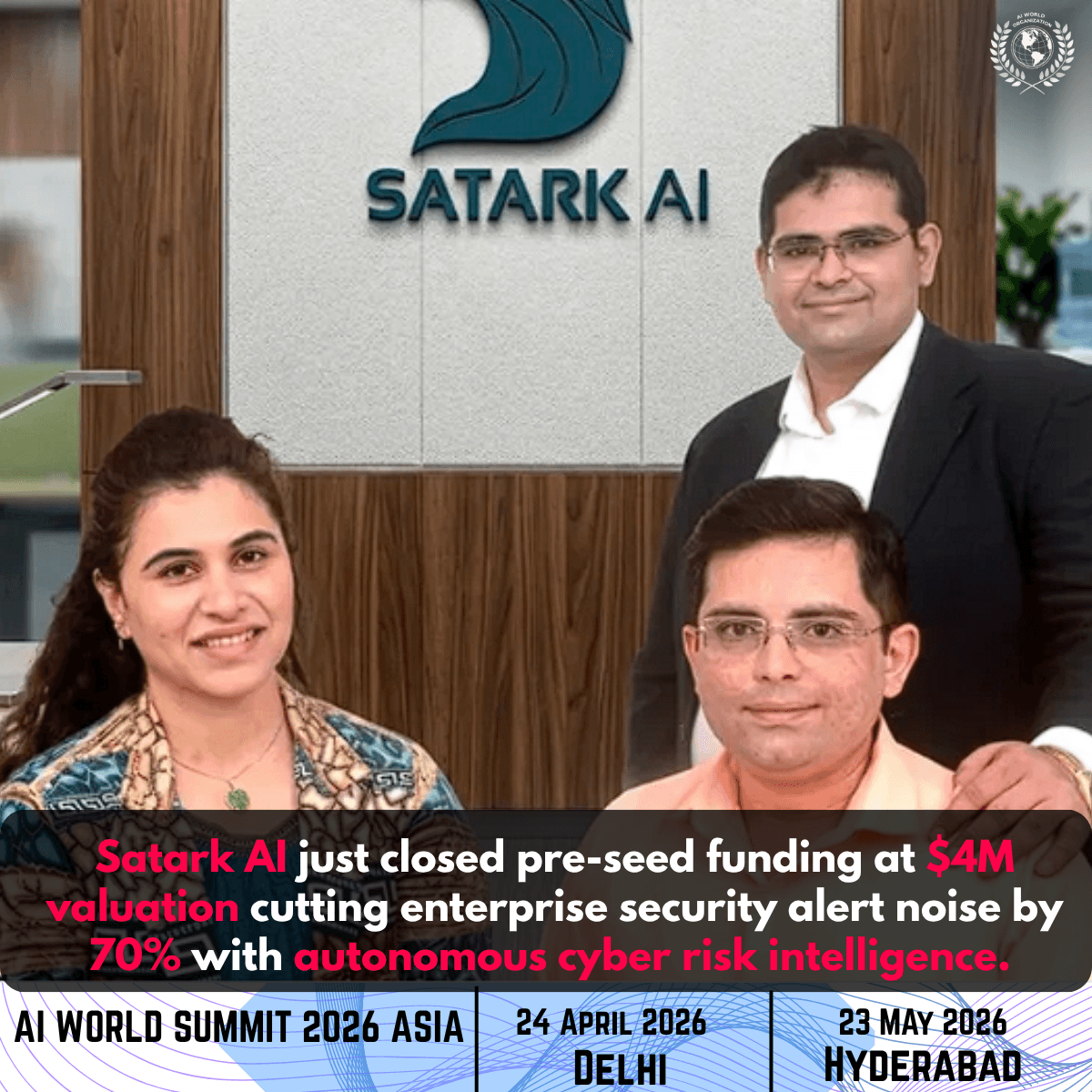
Ahmedabad-based Satark AI closes pre-seed funding at $4M valuation cap to build its AI-driven autonomous cyber risk intelligence platform for enterprises.
TL;DR
Satark AI, an Ahmedabad-based cybersecurity startup founded in June 2025, has closed a pre-seed funding round via convertible notes at a $4 million valuation cap. The company builds an autonomous cyber risk intelligence platform that cuts security alert noise by up to 70% and converts complex threat signals into clear, executive-ready risk decisions — already serving clients across India, Spain, and the UK.
Satark AI Secures Pre-Seed Funding to Power Its AI-Driven Cyber Risk Intelligence Platform
India's cybersecurity startup ecosystem is witnessing a new wave of innovation, and Satark AI is emerging as one of its most promising contributors. The Ahmedabad-based company has successfully closed its latest pre-seed funding round, raising an undisclosed amount through convertible notes at a valuation cap of $4 million. This development marks a significant step forward for a startup that is on a mission to fundamentally transform how enterprises understand and respond to cyber threats — not just as isolated technical events, but as strategic business risks that demand executive-level attention. In a world where security operations centres are drowning in alert fatigue and fragmented threat signals, Satark AI is building what could be the most intelligent cyber risk decision-making layer for the modern enterprise. This latest development in AI funding news has caught the attention of the global cybersecurity investment community and underlines the growing appetite for AI-native security platforms coming out of India.
The round comes just a few months after the startup had secured its first pre-seed investment from Infynno Solutions at a $3 million valuation cap in October 2025, reflecting a clear upward trajectory in investor confidence. Now raising at a higher valuation cap with angel investors backing the vision through convertible notes, Satark AI is steadily building the financial and operational foundation needed to scale its autonomous cyber intelligence platform. The progression from one pre-seed tranche to another, with a rising valuation cap, speaks volumes about how the team has been executing against its roadmap and articulating the commercial potential of its platform to stakeholders. The AI funding landscape across India has been maturing rapidly, and Satark AI's back-to-back pre-seed raises are a testament to that momentum — particularly in the intersection of generative AI and enterprise cybersecurity.
From Alert Chaos to Actionable Intelligence: The Satark AI Vision
Every enterprise security team knows the problem well. Thousands of alerts flood in every single day across various security tools — firewalls, endpoint protection systems, identity management platforms, and cloud infrastructure monitoring dashboards. Most of these alerts go unexamined, buried under the sheer volume of noise. Security analysts spend the majority of their time triaging low-priority events instead of focusing on what truly matters — the threats with the potential to cause real damage to business operations. The result is an overwhelming amount of wasted effort, increased risk of missing genuine threats, and a deep disconnect between the security team and the business leadership that needs to understand risk in plain, decision-ready language.
This is precisely the gap Satark AI was built to address. The platform positions itself as an intelligent decision layer sitting atop an enterprise's existing security stack, integrating with widely deployed tools such as SIEM (Security Information and Event Management), XDR (Extended Detection and Response), and IAM (Identity and Access Management) solutions. Rather than replacing these tools, Satark AI acts as a reasoning and synthesis engine — taking the fragmented, raw signals coming from all of these systems and converting them into no more than 10 actionable risk decisions for the security and executive team. According to the company, its platform is capable of eliminating up to 70% of security alert noise, which is a remarkable achievement in an industry where alert fatigue is considered one of the most critical unsolved challenges in cyber operations. The implications for AI funding in this specific niche are enormous, as enterprises worldwide are increasingly willing to invest in intelligence layers that make their existing security investments more productive.
What makes Satark AI's approach particularly compelling is its framing of cybersecurity not as a purely technical challenge but as a business risk governance challenge. The platform is designed to translate security signals into the language of business — helping CISOs, risk officers, board members, and executives understand exactly what is at stake, what the likelihood of impact is, and what decisions need to be made. This executive-facing intelligence layer is something that has been missing from most security vendor offerings, which tend to be deeply technical and siloed. By bridging the gap between the security operations floor and the boardroom, Satark AI is carving out a unique and highly differentiated position in an increasingly crowded cybersecurity market. The latest AI funding news surrounding the company is a clear validation that this positioning is resonating with investors who understand the future trajectory of enterprise security spending.
Founders and the Force Behind Satark AI
Satark AI was founded in June 2025 by a team of three — Rutvij Vora, Hitaishu Vora, and Kaivashin Sethna. Despite being less than a year old at the time of its latest funding round, the company has already demonstrated the kind of traction and vision that investors in the early-stage AI startup ecosystem look for. The founding team set out to build something ambitious: an Autonomous Cyber Intelligence Platform that could replicate and augment the decision-making capabilities of experienced Chief Information Security Officers. In practice, this means Satark AI isn't just automating repetitive tasks — it is attempting to encode strategic cybersecurity judgment into an AI-native system.
Rutvij Vora, the co-founder and CEO, has spoken about the core thesis behind the company with clarity. The vision, as articulated at the time of the earlier Infynno Solutions investment, is to build "the foundation for how cyber leadership will operate in the AI era." This is not simply a productivity tool or a dashboard upgrade — it is a fundamentally rethought architecture of how cybersecurity intelligence should flow through an organization. The founding team recognized early on that the traditional CISO-led security function, while valuable, is often stretched thin, under-resourced, and siloed from broader business decision-making. By building an AI layer that continuously reasons, advises, and governs cybersecurity functions, Satark AI is essentially creating an always-on, scalable cyber leadership infrastructure that grows smarter with every interaction.
The startup has already achieved early global traction, with customers across India, Spain, and the United Kingdom — a remarkable footprint for a company that has barely crossed its first year of existence. This cross-border adoption is a strong signal that the problem Satark AI is solving is not limited to any single geography or regulatory environment. Enterprises globally are grappling with the same challenge of cyber alert overload, governance complexity, and the need for real-time, executive-ready risk intelligence. As AI funding news from the Indian startup ecosystem continues to gain international attention, Satark AI's early global presence gives it a compelling narrative for its next raise and its broader commercial ambitions.
Platform Architecture: How Satark AI is Redefining Cyber Risk Management
At the technical core of Satark AI is a network of intelligent agents — a multi-agent AI architecture where different agents are responsible for distinct domains of the cybersecurity function, including policy management, risk assessment, compliance monitoring, threat detection, and governance oversight. These agents work in coordination, continuously exchanging information and updating their assessments based on incoming data streams. This cooperative intelligence model is what allows the platform to maintain a holistic, real-time picture of an organization's cyber risk posture — something that individual point solutions or siloed dashboards have never been able to deliver effectively.
One of the most innovative aspects of the platform is its use of large language models (LLMs) to power dynamic compliance automation. Traditional compliance frameworks are static — they are defined at a point in time, and organizations map their controls to those frameworks periodically, typically during audits. The problem is that the threat landscape and an organization's asset environment are constantly changing, which means static compliance assessments are almost always stale by the time they are reviewed. Satark AI's LLM-powered compliance engine solves this by continuously mapping asset-level controls to evolving compliance frameworks while integrating real-time threat intelligence from external sources. This means that as new vulnerabilities emerge, as new assets are added to the organization's environment, or as regulatory requirements change, the platform's compliance posture updates dynamically — eliminating the lag that has historically made compliance a lagging indicator of risk rather than a leading one. This innovation is directly relevant to AI funding trends in the RegTech and GovTech sectors, where investors are increasingly looking for platforms that bring intelligence and dynamism to traditionally manual, audit-driven processes.
The platform also incorporates a Human-in-the-Loop (HITL) design philosophy, which ensures that every AI-assisted recommendation or decision remains transparent, accountable, and auditable. This is a critically important design choice in the context of enterprise cybersecurity, where decisions can have severe legal, regulatory, and reputational consequences. HITL architecture means that while the AI does the heavy lifting of processing signals, synthesizing context, and generating recommendations, human professionals remain in control of final decisions. This balance between AI autonomy and human accountability is one of the defining characteristics of next-generation enterprise AI platforms, and Satark AI's early commitment to this principle positions it well for adoption in highly regulated industries such as banking, insurance, and healthcare — sectors where AI governance and explainability are non-negotiable.
Beyond its core cyber risk intelligence platform, Satark AI is also developing a suite of specialized AI-driven capabilities that expand its value proposition across adjacent domains. These include fraud detection systems for banks and fintechs, deepfake protection tools, and AI-powered systems for legal and emergency response. While these offerings are still in development, they reflect the startup's broader vision of building an intelligence infrastructure that goes beyond cybersecurity in the narrow sense and extends into every domain where AI-driven risk intelligence can create business value. As AI funding news from across the globe continues to highlight the scale of enterprise investment in AI-native risk management tools, Satark AI's expanding product portfolio positions it as a potential platform company rather than a point solution.
Strategic Use of Funds: Enterprise Pilots and the Road to Scale
The capital raised in this latest pre-seed round is earmarked for a very specific and strategically sound purpose: running structured pilot deployments with enterprise-grade and growth-stage companies. These pilots are designed to do two things simultaneously — validate the platform's impact on real-world security operations and demonstrate its ability to improve executive-level decision-making around cyber risk. By focusing the deployment strategy on pilot engagements rather than broad commercialization, Satark AI is following a disciplined go-to-market approach that prioritizes product validation over premature scaling. This is particularly wise for a platform that is asking organizations to integrate deeply with their existing security stack and trust AI to synthesize and surface their most critical risk signals.
Each pilot is expected to generate a rich dataset of real-world security signals and decision outcomes, which will in turn feed back into the AI models powering the platform, making it progressively smarter and more accurate. This data flywheel effect is one of the most powerful dynamics in enterprise AI platform businesses — the more the platform is used, the better it gets, creating a compounding advantage that becomes increasingly difficult for competitors to replicate. Investors tracking AI funding trends in the enterprise security space will recognize this as one of the most valuable structural advantages an early-stage platform can build, especially when the data involved is highly sensitive, domain-specific, and difficult to synthesize from public sources.
The startup is also expected to use a portion of the funds to expand its engineering and research teams, particularly in areas related to AI model development, integrations with enterprise security tools, and the development of its specialized fraud detection and deepfake protection capabilities. Building the right team at the pre-seed stage is critical for any deep-tech startup, and Satark AI's Ahmedabad base gives it access to a strong pool of technical talent from Gujarat's growing technology ecosystem. As AI funding news from Tier-2 Indian cities begins to attract more attention, Satark AI's success is likely to inspire other deep-tech founders in the region, reinforcing the narrative that world-class AI companies can be built from anywhere in India.
India's Cybersecurity Startup Ecosystem Gets a Strategic Boost
India has long been one of the world's largest consumers of cybersecurity products and services, yet it has historically been a modest producer of indigenous cybersecurity intellectual property. That narrative is changing rapidly, driven by a combination of rising domestic cybersecurity incidents, increasing regulatory requirements from bodies like SEBI, RBI, and CERT-In, and a new generation of technically sophisticated founders who understand both the AI opportunity and the security domain deeply. Satark AI's back-to-back pre-seed raises are part of a broader wave of AI funding flowing into the Indian cybersecurity startup space, with investors recognizing that India's unique combination of deep tech talent, massive enterprise market, and complex regulatory landscape makes it an ideal proving ground for AI-native security platforms.
The global cybersecurity market is expected to grow substantially over the next decade, driven by accelerating digital transformation, the proliferation of connected devices, increasing sophistication of threat actors, and the growing use of AI by both defenders and attackers. Within this expanding market, the segment focused on autonomous risk intelligence and AI-driven governance is projected to see particularly strong growth, as enterprises recognize that traditional rule-based and perimeter-focused security strategies are no longer adequate. Satark AI is positioning itself to capture a meaningful share of this market by offering a platform that doesn't just detect threats but contextualizes them, prioritizes them, and translates them into board-level risk language that drives action.
From a broader industry perspective, Satark AI's progress is a piece of an exciting and rapidly evolving landscape in AI funding news from the Indian tech ecosystem. The company joins a growing cohort of Indian AI startups that are building world-class products targeting global enterprise markets, with a sharp focus on AI's ability to automate and augment expert human judgment in high-stakes domains. As the platform matures through its pilot engagements, and as the founding team builds its go-to-market capabilities, Satark AI has the potential to become a significant player in the global enterprise cybersecurity market — not just as an Indian startup, but as a genuinely differentiated AI intelligence platform that solves one of the most persistent and costly problems in modern security operations. The AI World is watching this space closely, as developments like Satark AI's funding milestone represent exactly the kind of innovation that defines the next frontier of enterprise AI adoption.