Sandbar Raises $23M to Build AI Note-Taking Ring
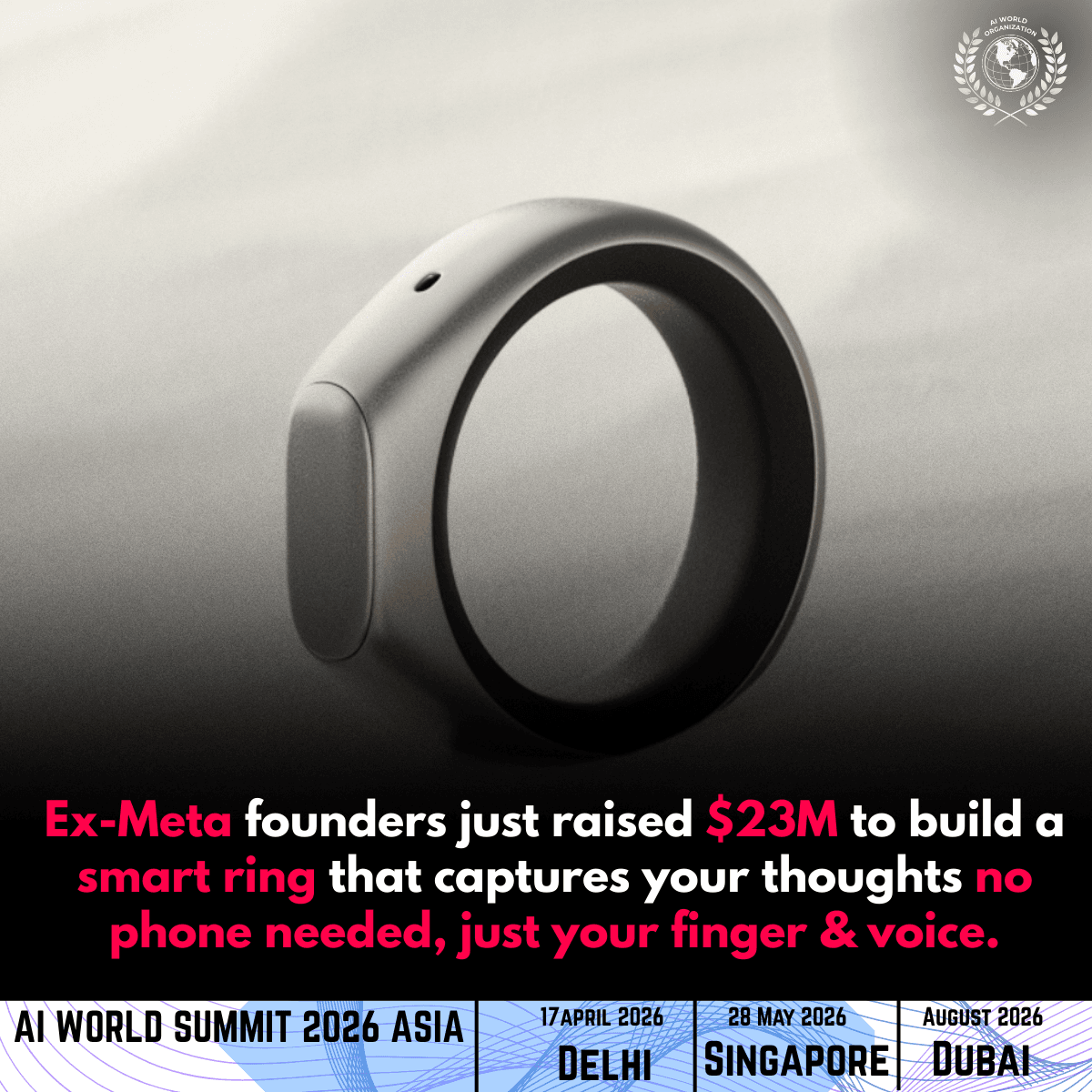
Sandbar secures $23M Series A led by Adjacent and Kindred Ventures to develop Stream, an AI-powered note-taking ring built by ex-Meta founders.
TL;DR
Sandbar, founded by two ex-Meta engineers, has raised $23M in Series A funding to bring its Stream ring to market — a smart ring with a mic and touch panel that lets you capture voice notes and talk to an AI assistant without touching your phone. With $36M raised in total, the company is gearing up for commercial launch this summer.
Sandbar Raises $23M Series A to Redefine Wearable Tech with an AI-Powered Note-Taking Ring
The wearable technology space has long been dominated by health trackers and fitness monitors, but a new wave of smart devices is now pushing boundaries beyond step counts and sleep patterns. Among the most intriguing entrants in this evolving landscape is Sandbar, a startup that has secured $23 million in a Series A funding round to develop the Stream — a smart ring built not for your body's vitals, but for your mind's ideas. This latest AI funding news signals a broader shift in how investors and entrepreneurs are thinking about wearable AI, and what it means for the future of human-computer interaction in our daily lives.
The round, led by Adjacent and Kindred Ventures, marks a significant vote of confidence in a product category that many considered too niche just a few years ago. With AI now deeply embedded in how professionals work, communicate, and manage information, the timing of Sandbar's fundraise couldn't be more strategic. At The AI World Organisation, we track the most transformative AI funding developments across the globe, and this particular round stands out not just for the dollar amount, but for the bold vision it represents — merging wearable hardware with intelligent, conversational AI in a way that feels genuinely practical.
From Meta Hallways to Hardware Startups: The Founders Behind Sandbar
Sandbar was co-founded by Mina Fahmi and Kirak Hong, both of whom previously worked at Meta. Their shared experience at one of the world's most powerful technology companies gave them a firsthand understanding of how human-computer interaction is evolving — and more importantly, where it still falls short. The friction of pulling out a phone to jot down a thought, voice-type a reminder, or interact with an AI assistant felt increasingly unnecessary to them. If wearables could monitor your heartbeat passively, why couldn't they capture your thoughts just as effortlessly?
That question became the founding premise of Sandbar. The two engineers spent over two years developing the Stream ring before publicly unveiling it last year following a rigorous period of testing with early adopters. Their team, which currently numbers around 15 people, is stacked with engineers who have previously worked at iconic technology companies including Amazon, Google, Apple, and Fitbit. This is not a group of first-time builders experimenting with hardware on a shoestring budget — these are seasoned professionals who understand the complexities of building consumer electronics, developing machine learning pipelines, and shipping products at scale.
The depth of the team also speaks to the ambition of what Sandbar is building. Designing a ring that captures audio clearly, integrates seamlessly with a mobile AI assistant, and fits comfortably on a finger requires expertise that cuts across mechanical engineering, signal processing, machine learning, and UX design. The $23 million in fresh AI funding will directly fuel expansion across the software and machine learning teams, and Sandbar also plans to bring on marketing staff as it prepares for a broader commercial launch this summer.
The Stream Ring: What Makes It Different from Every Other Smart Ring
To understand why this AI funding news matters, you first need to understand what the Stream ring actually does — and how radically it differs from the smart rings that have come before it. Devices like the Oura Ring have built strong followings by helping users understand their bodies better: tracking recovery, sleep quality, heart rate variability, and other biometric signals. The Stream ring does none of that. Instead, Sandbar has made a deliberate choice to focus entirely on cognitive productivity.
The Stream ring features two core hardware components that distinguish it from its competitors: a built-in microphone and a touch-sensitive panel. Together, these components allow users to record voice notes, issue commands to an AI assistant, and control media playback — all without ever touching their phone. The microphone is specifically configured for close-range recording, meaning users bring their hand close to their face when they want to capture a note or interact with the assistant. This might sound like an unusual design choice, but it serves a critical purpose: it prevents unintended recordings and ensures that every captured note is a deliberate action by the user.
This kind of intentionality is central to Sandbar's product philosophy. Rather than building a device that passively listens and records everything — a model that raises serious privacy concerns and creates an overwhelming flood of low-quality data — Sandbar has prioritized precision and purpose. When a user lifts their hand and speaks, they mean it. The result is a note-taking experience that is both more reliable and more respectful of personal boundaries.
The companion mobile app ties everything together. Captured notes are processed and organized through the app, with AI providing structure, context, and recall capabilities. One of the most frequently cited use cases among early users is the ability to capture fragmented ideas on the go — snippets of a presentation, a reminder for a trip, a quick task note — and let the AI organize these into something coherent and actionable later. The company has noted that some of its early users interact with the Stream ring dozens of times per day, integrating it naturally into their professional and personal routines.
AI Funding Momentum: How $36 Million in Total Capital Positions Sandbar for Scale
This $23 million Series A does not represent Sandbar's first time raising institutional capital. The company previously secured $13 million from True Ventures, bringing its total AI funding to approximately $36 million. The progression from seed-stage backing to a full Series A led by Adjacent and Kindred Ventures tells an important story about how investor confidence in Sandbar has grown as the product has developed and early traction has materialized.
The fact that the first batch of Stream ring preorders sold out last year was a critical proof point. In the hardware startup world, early sellouts are rare and meaningful signals. They indicate not just that the product generates curiosity, but that real consumers are willing to commit money in advance based on a vision and a promise. Sandbar opened a second round of preorders after the first sold out, and with a commercial shipping date expected this summer, the company is moving quickly from prototype phase to real-world deployment.
This AI funding news also arrives at a moment when the broader wearable AI category is beginning to attract serious attention. A number of startups and established players are exploring the idea of AI-enabled wearables that go beyond health monitoring — devices that serve as ambient intelligence tools, helping users manage information, communicate more efficiently, and stay organized without the constant interruption of screen-based interaction. Sandbar is among the earliest and most focused players in this space, and its $36 million in total funding gives it a meaningful runway to compete and iterate.
For investors like Adjacent and Kindred Ventures, backing Sandbar is a bet not just on a product, but on a paradigm shift in human-computer interaction. The smartphone has been the dominant interface for over a decade, but its limitations — the need to take it out, unlock it, open an app — are increasingly apparent in a world where people want instant, frictionless access to AI. A ring that sits on your finger and connects you to an intelligent assistant with a gesture represents a genuinely different approach to this challenge.
Building the Software Layer: The Road Ahead for Sandbar's AI Platform
While the Stream ring itself is a compelling piece of hardware, Sandbar's leadership is acutely aware that the long-term value of the product will be determined by the quality and capability of its software platform. Hardware can be copied or improved upon; a deeply integrated, intelligent software ecosystem creates the kind of stickiness and differentiation that builds lasting companies. This is why a significant portion of the new AI funding will be directed toward software development.
On the immediate roadmap, Sandbar plans to revamp the user interface of its mobile app, making it more intuitive and capable. The company is also developing a full web platform, which will allow users to access and manage their notes and AI-generated content from a desktop or laptop — an important step toward positioning the Stream ring as a serious productivity tool rather than a consumer novelty. Additionally, Sandbar is working to reduce the response latency of its AI systems, which will make the real-time interaction between ring and assistant feel more natural and instantaneous.
Looking further ahead, one of Sandbar's most exciting stated goals is enabling genuine conversational interaction with the AI assistant. Co-founder Mina Fahmi has acknowledged that users frequently ask follow-up questions about notes they did not finish recording, seeking context, clarification, or elaboration. The vision is an assistant that not only captures your thoughts but engages in dialogue with you about them — helping you develop half-formed ideas, recall relevant context from past notes, and synthesize information across multiple captures.
This conversational layer represents the true frontier of what an AI-powered wearable can become. It moves the device from being a passive recording tool to an active thinking partner — something that understands your workflow, anticipates your needs, and helps you stay intellectually agile throughout the day. Achieving this will require advances in both the underlying machine learning models and the latency of the system, but Sandbar's engineering team has the background and the capital to pursue this goal seriously.
The AI World Organisation's Perspective: What Sandbar Signals for the Future of Wearable AI
At The AI World Organisation — a global apex body representing over 5,000 AI leaders across APAC, Europe, and the Americas — we view developments like Sandbar's Series A as part of a much larger transformation unfolding across the technology landscape. AI is no longer confined to cloud servers, enterprise software, or social media algorithms. It is moving onto our bodies, into our ears, and now onto our fingers. The race to build the most intuitive, least intrusive AI interface is well and truly underway.
The broader AI funding news ecosystem reflects this trend powerfully. Investors are channeling capital into startups that are rethinking how humans interact with intelligent systems, and the emphasis is increasingly on ambient, embodied AI — technology that is present and useful without demanding constant attention. Smart rings, AI earbuds, vision-based wearables, and other form factors are all competing to become the preferred interface layer between people and the AI models that are rapidly transforming how we work and think.
Sandbar's approach is particularly notable because it is grounded in a clear and specific use case: capturing and organizing thought. This is a universal need that spans virtually every profession and lifestyle, from software engineers and executives to writers, students, and creatives. By building a device that makes thought capture as effortless as possible and then pairing it with an AI that adds structure and intelligence, Sandbar is addressing a genuine gap in the market — one that no smartphone app or voice assistant has fully solved.
The company's decision to hire marketing staff alongside its technical team also reflects a maturity of thinking that is often absent in deep tech startups. Building a great product is necessary but not sufficient; reaching and educating the right audience, especially for a novel category like AI note-taking wearables, requires deliberate and sophisticated go-to-market execution. The AI World Organisation closely monitors how AI-native companies scale their market presence, and Sandbar's approach here bears watching.
As the Stream ring prepares for commercial shipping this summer, and as Sandbar continues to build out its software platform and expand its team, this startup is shaping up to be one of the more interesting AI companies to follow in 2026. The convergence of wearable hardware, intelligent AI, and a genuinely useful daily application makes for a compelling combination — and with $36 million in total AI funding behind it, Sandbar has the resources to find out just how far this combination can go.