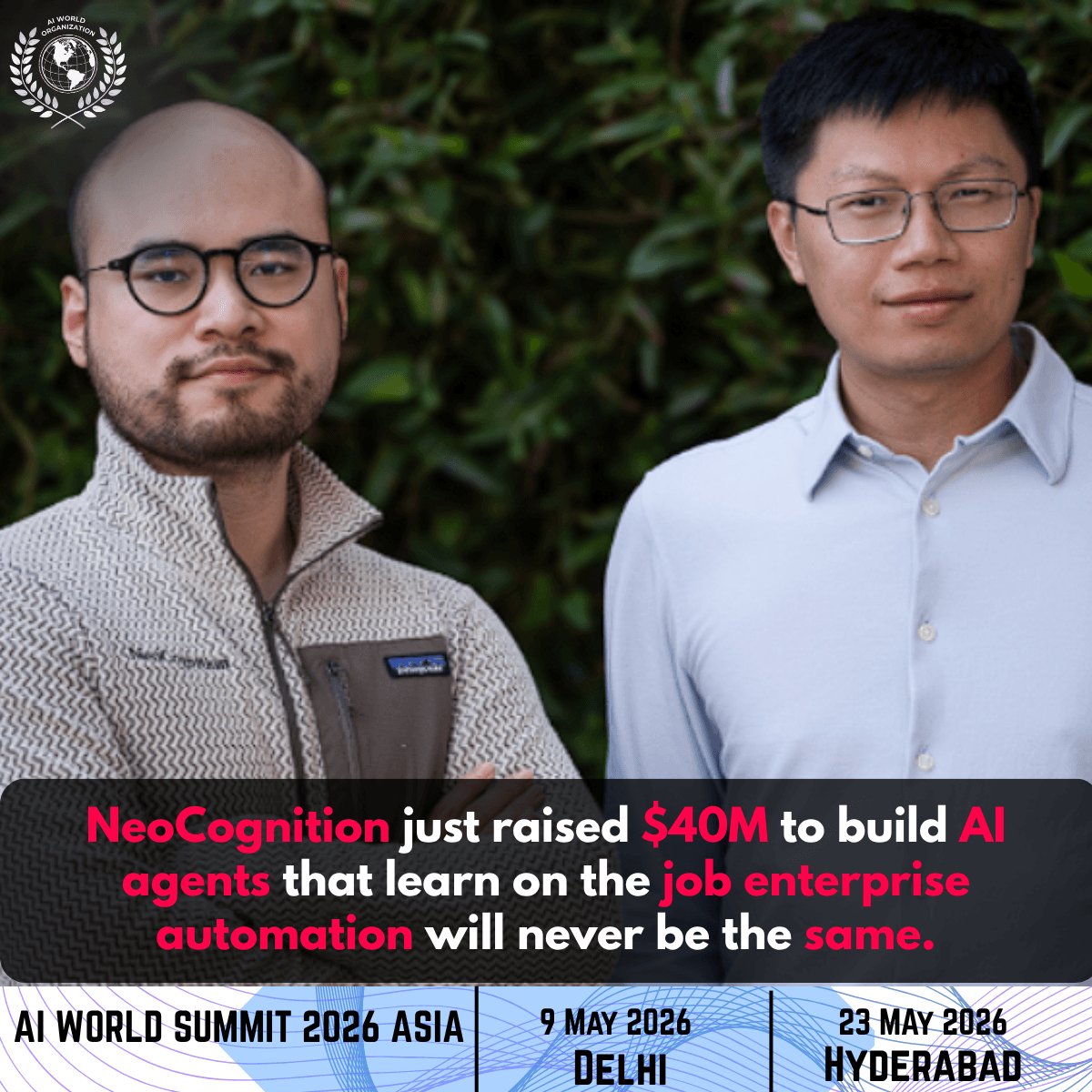
NeoCognition Raises $40M for Self-Learning AI Agents
NeoCognition exits stealth with $40M seed funding to build self-learning AI agents that specialise on the job, backed by Intel CEO and top AI researchers.
TL;DR
NeoCognition, a San Francisco-based startup born out of Ohio State University research, has raised $40 million in seed funding to build AI agents that actually learn and improve through real work experience — rather than staying frozen after deployment. Backed by top-tier investors and advisors including Intel's CEO, the company is targeting complex enterprise tasks that today's AI agents simply cannot handle reliably.
NeoCognition Raises $40M Seed Funding to Build Self-Learning AI Agents for the Enterprise
For years, the biggest promise of artificial intelligence in business has been autonomy — the idea that software could one day handle complex, evolving tasks the way a seasoned employee would: learning on the fly, adapting to new challenges, and growing sharper with every experience. That promise has mostly remained just that — a promise. Most enterprise AI agents today are rigid, pre-programmed tools that break down the moment they encounter a situation their developers didn't plan for. A San Francisco-based startup called NeoCognition believes it has found a way to change that, and the venture community is taking notice. In a significant piece of AI funding news, the company has officially emerged from stealth mode after securing $40 million in seed funding — one of the largest seed rounds in the AI agent space this year — signalling strong investor confidence in its vision of agents that genuinely learn on the job.
The Funding Round and the Investors Behind It
The $40 million seed round was co-led by Cambium Capital and Walden Catalyst Ventures, with Vista Equity Partners also participating as a notable backer. What makes this round particularly remarkable, even by the lofty standards of current AI funding, is the calibre of the angel investors and advisors who chose to align themselves with the company. Intel CEO Lip-Bu Tan, Databricks co-founder Ion Stoica, and three of the most cited names in academic AI research — Dawn Song, Ruslan Salakhutdinov, and Luke Zettlemoyer — are all part of NeoCognition's extended team as advisors and angel investors.
That kind of advisory constellation is rarely assembled at the seed stage. It speaks to the depth of respect the founding team commands within the broader AI research community, and it adds a layer of credibility to NeoCognition's technical claims that pure venture backing alone could not provide. In the current climate of AI funding, where capital is flowing freely but genuine technical differentiation is scarce, having some of the world's most respected AI researchers vouch for your approach is a powerful statement. Landon Downs, Managing Partner at Cambium Capital, put it plainly: "At the core of NeoCognition is a novel learning mechanism that will allow agents to specialise very quickly. We have strong conviction in the team's expertise and believe their research is charting a new path toward specialised intelligence."
The involvement of Vista Equity Partners — a firm better known for late-stage enterprise software investments — is also worth noting. It suggests that even growth-stage investors are watching the AI agent space closely enough to place early bets on what they believe could become foundational enterprise infrastructure.
The Founding Team and the Research That Started It All
NeoCognition was built by a team with unusually deep academic roots. The company was co-founded by Yu Su, Xiang Deng, and Yu Gu, who collaborated together inside Su's AI agent research lab at Ohio State University. Yu Su, a Sloan Research Fellow, is not a newcomer to the field of AI agents — in fact, his lab was building LLM-based agents before large language models became a household name, well before the ChatGPT moment in late 2022 redefined public understanding of what AI could do.
The team's research portfolio is impressive and widely cited across the industry. Projects such as Mind2Web, which explored how AI agents could navigate real-world websites, and MMMU, a demanding multi-discipline evaluation benchmark, have gone on to influence development roadmaps at some of the most prominent AI labs in the world, including OpenAI, Anthropic, and Google. These are not names that borrow lightly from outside research — the fact that their teams actively reference and build upon NeoCognition's foundational work gives a strong indication of just how ahead of the curve this group has been.
The transition from academic lab to commercial startup is often fraught, but in this case, the founders are not pivoting away from what they know. They are doubling down on it — taking research that has already proven its influence in academic circles and stress-testing it against the unforgiving demands of real enterprise environments. This combination of deep theoretical grounding and commercial ambition is exactly what large-scale AI funding rounds at the seed stage tend to reward, and NeoCognition's trajectory fits that pattern well.
A Self-Learning Architecture That Mirrors Human Intelligence
The core technological innovation that NeoCognition is bringing to market is deceptively intuitive in concept, even if it is technically sophisticated in execution. Yu Su has described the company's guiding philosophy as one inspired by the way humans actually build expertise. "The true power of human intelligence is the ability to continuously learn and specialise," he explained. "Our approach mirrors how humans gain expertise on the job — through building a structured model of their micro-world — and would eliminate the extensive manual customisation required by current models."
This is a pointed critique of how the vast majority of AI agents work today. Whether they are built on top of OpenAI's models, Anthropic's Claude, or Google's Gemini stack, most enterprise AI agents are trained, deployed, and then essentially frozen. They can process information and execute tasks within the boundaries they were designed for, but they do not improve through use. Every new edge case, every unfamiliar workflow, every organisation-specific quirk has to be manually addressed by engineers and product teams. The result is AI that is expensive to maintain, slow to adapt, and often frustrating to scale across a large organisation.
NeoCognition's answer is an agent architecture that does not freeze at deployment. Instead, its agents build what the company describes as a "structured model of their micro-world" — essentially an evolving internal representation of the specific environment they are operating in. Over time, as the agent encounters more situations, completes more tasks, and receives feedback on its performance, this internal model deepens. The agent becomes faster, more accurate, more cost-effective to run, and — critically — safer to trust with high-stakes tasks. All of this happens without requiring constant human intervention to retrain or reconfigure the system. It is, in the most direct sense of the word, learning on the job.
Standing Apart in a Crowded Market
The enterprise AI agent market is genuinely crowded. NeoCognition enters a space where well-funded competitors are already fighting for enterprise contracts and developer mindshare. On the specialised side, companies like Cognition Labs and Adept have built AI agents tailored for specific domains — software engineering, data analysis, and so on. On the general-purpose side, the giants loom large: OpenAI with its operator frameworks, Anthropic with Claude's tool-use capabilities, and Google with its Gemini-based agent integrations across Workspace.
What NeoCognition is proposing is something that sits deliberately between these two camps, and arguably above them. Rather than building domain-specific agents that are powerful but narrow, or general-purpose agents that are broad but static, NeoCognition is building general-purpose agents that can become domain-specific through experience. The distinction matters enormously in enterprise settings. A company deploying an AI agent to manage procurement workflows, for example, does not want a tool that only understands procurement in the abstract — it wants one that understands its procurement process, its vendor relationships, its internal approval chains. That kind of contextual specialisation currently requires months of manual configuration. NeoCognition's architecture is designed to achieve it organically, through use.
This positions the company well for the segment of enterprise use cases that today's AI agents simply cannot reliably handle — tasks that are too complex, too context-dependent, or too high-risk to hand off to a static model. The company has explicitly stated that its initial focus will be on enterprise tasks that are "currently too risky or complex for today's general AI agents." That is a meaningful scope of ambition, and recent AI funding trends suggest that investors see enormous commercial potential in exactly this problem space.
What the $40M Will Be Used For
With $40 million now in the bank, NeoCognition is moving quickly from research institution to commercial enterprise. The company has outlined a clear set of priorities for how the seed capital will be deployed. First and most urgently, it will be used to significantly expand the research team — bringing in additional scientists and engineers who can push the self-learning architecture further and stress-test it across a wider range of enterprise environments.
Second, the funding will support the transition from academic proof-of-concept to production-grade software. There is always a significant gap between a research system that works impressively in a lab setting and a commercial product that can be trusted to run reliably inside a Fortune 500 company's operations. Bridging that gap requires engineering investment, infrastructure build-out, and the kind of iterative testing that only real-world enterprise deployments can provide. NeoCognition will be actively seeking enterprise partners for early deployments as it refines its systems toward commercial launch.
Third, the company will invest in hiring across go-to-market, product, and operational functions — building out the full-stack commercial organisation that a well-funded startup needs in order to move beyond research credibility and into sustained revenue generation. In the broader context of AI funding news coming out of Silicon Valley, this round is a reminder that the most compelling bets being placed right now are not on companies building yet another LLM wrapper, but on those developing genuinely new capabilities at the infrastructure level. NeoCognition's self-learning architecture is precisely that — a foundational capability, not an application layer — and that is what makes this $40 million seed round one of the more significant AI funding stories of 2026.


