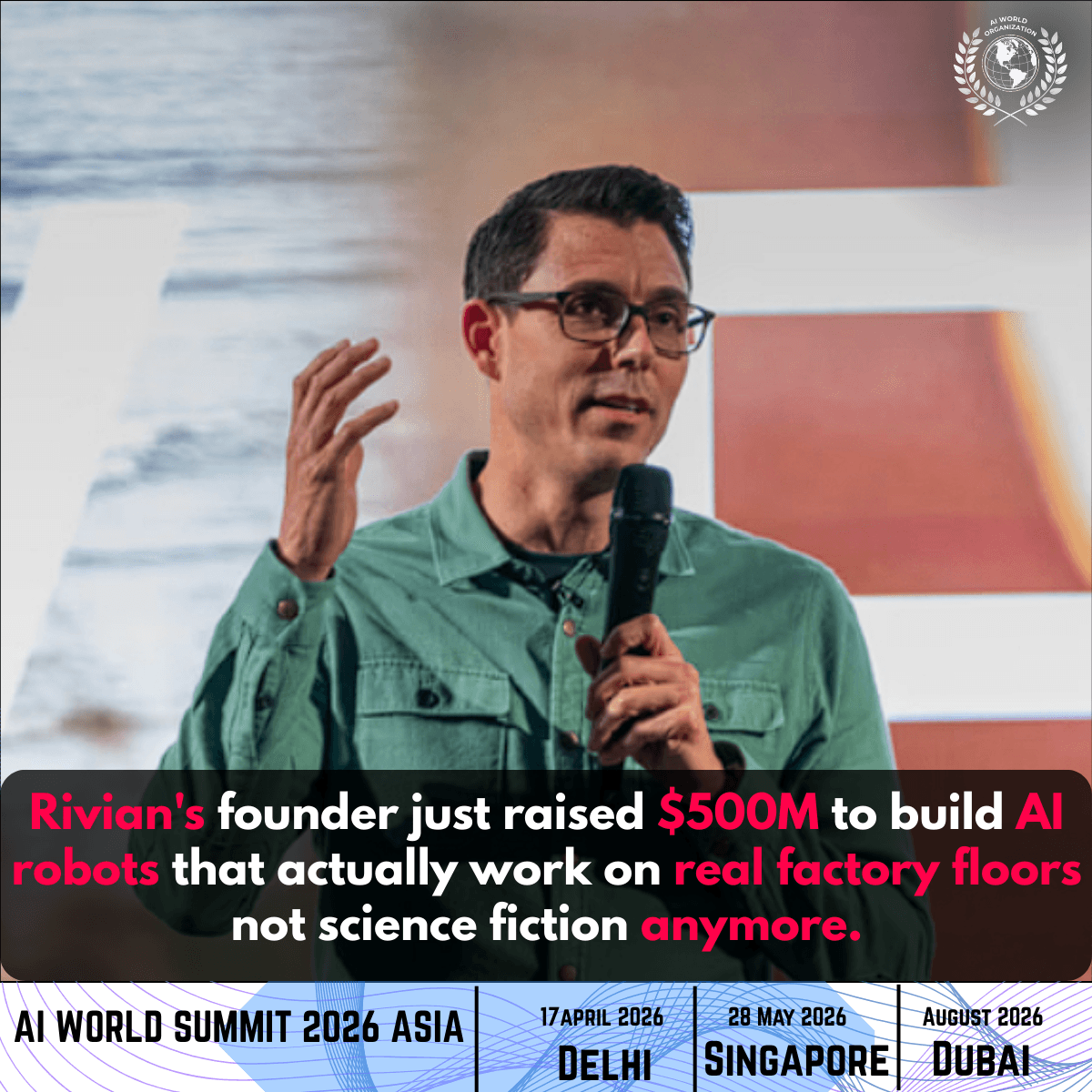
Mind Robotics Raises $500M for AI Industrial Robots
Mind Robotics secures $500M Series A led by Accel and a16z to deploy AI-powered factory robots at scale, solving industrial labour shortages.
TL;DR
RJ Scaringe, the founder of electric vehicle company Rivian, has raised $500 million for his new venture, Mind Robotics, which is building AI-powered robots designed specifically for factory floors. Backed by top investors Accel and a16z, the company is valued at $2 billion and plans to deploy its robots inside Rivian's own manufacturing plants by end of 2026 — giving it a rare real-world data edge over rivals.
Mind Robotics Secures $500 Million Series A to Build the Future of AI-Powered Industrial Automation
The industrial manufacturing world has long wrestled with a stubborn challenge — most factory floors still depend heavily on human workers for tasks that traditional machines simply cannot manage. Conventional industrial robots, despite their strength and speed, are narrowly designed for repetitive, pre-programmed actions in highly controlled environments. The moment conditions change or a task demands genuine dexterity, contextual reasoning, or adaptive problem-solving, these older systems falter. This fundamental limitation has left a significant portion of industrial work resistant to meaningful automation, keeping labour costs high and production efficiency capped well below its potential. In a major development making waves across the global technology and investment landscape, Mind Robotics — a Palo Alto-based AI industrial robotics company — has stepped forward to tackle this very problem head-on, backed by some of the most respected names in venture capital. This landmark AI funding news signals a turning point not just for robotics, but for the entire future of manufacturing.
Mind Robotics announced a staggering $500 million Series A financing round, co-led by Accel and Andreessen Horowitz (a16z), making it one of the single largest early-stage funding rounds in the history of robotics. The round is expected to close later this month and brings the company's total funding to an impressive $615 million, following a $115 million seed round led by Eclipse Capital in late 2025. The startup has now been valued at approximately $2 billion, a figure that reflects not just investor confidence in the technology, but also the sheer scale of the industrial opportunity that Mind Robotics is pursuing. As AI funding news continues to dominate global headlines in 2026, this particular deal stands out for its ambition, its backing, and the unique competitive advantage the company carries from day one.
The Visionary Behind the Venture: RJ Scaringe and the Mind Robotics Origin Story
Mind Robotics was founded in 2025 by RJ Scaringe, who also serves as the CEO and founder of Rivian, the pioneering electric vehicle manufacturer. The company was formally spun out of Rivian in November 2025, with Scaringe taking on the role of chairman at Mind Robotics while continuing his leadership at Rivian. The genesis of the company is deeply intertwined with Scaringe's decade-long experience building one of the most complex, vertically integrated manufacturing operations in the automotive industry. At Rivian, he oversaw the design and execution of an entire production ecosystem — from vehicle architecture and battery systems to embedded software, supply chain management, and full-scale factory operations. That rare, end-to-end experience in physically building something at industrial scale is the very foundation upon which Mind Robotics was conceived.
The core insight driving the company is straightforward but powerful: the same engineering depth and real-world manufacturing intelligence that enabled Rivian to build electric vehicles at scale can now be channelled into building robots that are genuinely useful in those same manufacturing environments. Rather than developing technology in a laboratory and then trying to introduce it into factories later, Mind Robotics has the advantage of working within an active, high-pressure, high-scale production environment from the very beginning. This gives the company access to something most of its competitors simply do not have — a continuous, live stream of real manufacturing data that can be used to train, refine, and improve its AI models in real time. In the context of the ongoing wave of AI funding news sweeping through the technology sector in 2026, the Mind Robotics story is particularly compelling because of this built-in data advantage that very few startups can replicate.
Sarah Wang, General Partner at Andreessen Horowitz, articulated the rationale behind the firm's investment with clarity. She noted that RJ Scaringe is among a very rare category of founders who have actually built and scaled a vertically integrated hardware company from the ground up. At Rivian, he personally architected the full technology stack — spanning vehicle design, electronics, battery systems, embedded software, manufacturing processes, and supply chains — weaving each layer into a coherent and functional whole. According to Wang, that kind of systems-level leadership is precisely what it takes to build a genuinely generational robotics company, and it is exactly why a16z chose to back Scaringe and the Mind Robotics team at this scale.
What Mind Robotics Is Actually Building: A Full-Stack Platform for Industrial AI
At its core, Mind Robotics is developing what it describes as a full-stack industrial robotics platform. This means the company is not simply building a robot — it is simultaneously developing the AI foundation models that power the robots' decision-making, the purpose-built robotic hardware designed specifically for the demands of factory environments, and the deployment infrastructure needed to integrate these systems into real industrial settings at scale. This integrated, end-to-end approach is deliberate and reflects a hard-learned lesson from the broader hardware industry: the moment you break the stack and rely on third parties for critical layers of your product, you lose control over performance, reliability, and ultimately, outcomes.
The types of tasks Mind Robotics is targeting go well beyond what existing factory automation systems handle. The company is specifically focused on work that demands human-like dexterity, rapid adaptability to changing conditions, and the kind of physical reasoning that allows a worker to assess a situation and adjust their actions accordingly. These are the tasks — the picking, placing, assembly, and inspection activities that require judgment and fine motor control — that have resisted automation for decades. By combining advanced AI models with custom hardware and a rich stream of live manufacturing data from Rivian's facilities, Mind Robotics believes it can close this gap in a way that no previous approach has managed to do at scale.
One particularly noteworthy element of Mind Robotics' strategy is what it is deliberately choosing not to build. At a time when humanoid robots are attracting enormous media attention and billions of dollars in investment — with companies like Tesla building their Optimus platform and numerous other startups designing robots that walk and move like humans — Scaringe has been remarkably direct about why Mind Robotics is taking a different path. His reasoning, expressed with characteristic clarity, is that humanoid form factors are an unnecessary constraint when the goal is industrial utility. "Doing cartwheels does not create value in manufacturing," Scaringe has said, cutting to the heart of the issue. Mind Robotics is focused on traditional robot designs that are optimised for the actual tasks that need to be done in factories, not robots designed to mimic the human form for its own sake.
The Rivian Partnership: A Strategic Data Flywheel Unlike Anything in the Industry
The relationship between Mind Robotics and Rivian is one of the most strategically distinctive aspects of this story, and it is worth examining in detail because it fundamentally changes the competitive dynamics of what Mind Robotics can achieve. Rivian serves as both a major shareholder in Mind Robotics and as its primary partner and deployment environment. This means that Mind Robotics has immediate, ongoing access to a large-scale, active manufacturing facility — Rivian's factory in Illinois — where its robots can be trained, tested, and deployed in genuine production conditions from the earliest stages of the company's existence.
This arrangement creates what investors and industry observers have described as a data flywheel: as Mind Robotics deploys more robots in Rivian's factory, those robots generate more real-world operating data, which feeds back into improving the AI models, which in turn makes the robots more capable, which enables broader deployment, and so the cycle continues and accelerates. The value of this feedback loop cannot be overstated. Many robotics startups spend years and enormous amounts of capital trying to generate sufficient training data before they can even begin meaningful deployment. Mind Robotics effectively starts ahead of that curve by virtue of its structural relationship with one of the most technically sophisticated manufacturing operations in the EV industry.
Beyond the data advantage, Mind Robotics also benefits directly from Rivian's deep electro-mechanical engineering expertise and the institutional production knowledge that has been built up over years of manufacturing complex electric vehicles. The company's team carries an intimate understanding of what actually goes wrong on a factory floor, what tasks are genuinely difficult for automated systems, and what it takes to maintain reliability across continuous, multi-shift operations. This depth of practical knowledge is the kind of thing that simply cannot be bought or fast-tracked, and it gives Mind Robotics a meaningful head start over rivals who are approaching the industrial market from a purely software or research background.
Scaringe has confirmed that Mind Robotics plans to have a large number of its robots deployed within Rivian's factories by the end of 2026, making this not a distant roadmap aspiration but an immediate operational commitment. This accelerated timeline reflects the company's confidence in its technology and its access to a ready deployment environment, and it will serve as a critical proof point for the broader market.
Investor Confidence and the Global Context of AI Funding in Industrial Robotics
The scale and quality of the AI funding secured by Mind Robotics speaks volumes about where institutional capital is flowing in 2026. Accel and Andreessen Horowitz are not simply well-known names — they are among the most selective and strategically astute venture capital firms in the world, with track records that include some of the most successful technology companies of the past two decades. When both firms agree to co-lead a single round at this size, it is a strong signal that the investment thesis is not speculative but grounded in a clear and validated market opportunity.
Sameer Gandhi, partner at Accel, who will join the Mind Robotics board as part of the investment, expressed his firm's conviction in terms of the team's proven execution capability. He noted that the Mind Robotics team helped build one of the most ambitious manufacturing operations in the EV industry, and that this kind of execution does not happen by accident. According to Gandhi, it reflects the quality and discipline of the people behind it. He described Scaringe as both a disciplined and visionary leader, and expressed Accel's belief that AI industrial robotics represents one of the most exciting and consequential technological shifts of the current era.
This assessment aligns with broader trends in the AI funding news landscape. According to reports from the Wall Street Journal, at the current pace of investment in 2026, the total capital flowing into AI and robotics ventures could double compared to 2025 levels. The Mind Robotics raise is emblematic of this shift — investors are no longer placing small, exploratory bets on robotics but are committing substantial capital to companies they believe can achieve real industrial scale. The $615 million total raised by Mind Robotics since its founding in 2025 — just over a year ago — is a testament to how quickly confidence in well-positioned AI companies can translate into large-scale financial commitments from the world's leading investors.
At The AI World Organisation, we see this development as a defining moment in the maturation of physical AI — the application of artificial intelligence not in the digital realm, but in the tangible, physical world of factories, supply chains, and industrial production. As a global apex body representing over 5,000 AI leaders across APAC, Europe, and the Americas, The AI World Organisation has consistently highlighted industrial AI as one of the most transformative and economically significant domains for AI deployment. The Mind Robotics funding round validates what many in our network have been observing for some time: the industrial sector is the next great frontier for AI, and the companies that can solve the hard problems of dexterity, adaptability, and real-world deployment at scale stand to create enormous value.
What This Means for the Future of Manufacturing, Labour, and Global Competitiveness
The implications of Mind Robotics' technology and funding extend well beyond the company itself. Scaringe has consistently framed the work of Mind Robotics in terms of a much larger challenge facing global industry — the dual pressure of labour shortages and international competitiveness. Manufacturing labour shortages are a significant and growing problem across the United States, Europe, and many parts of Asia. An ageing workforce, shifting career preferences among younger generations, and the increasing complexity of modern manufacturing tasks have all contributed to a situation where factories cannot reliably staff the roles they need to fill. Advanced AI-powered robotics is increasingly being seen not as a threat to workers, but as a necessary solution to gaps that human labour alone cannot fill.
At the same time, global competitiveness in manufacturing is under intense pressure. Countries and companies that can automate more effectively will be able to produce goods faster, at higher quality, and at lower cost. Those that cannot will increasingly struggle to compete. Scaringe has been direct about this dynamic, stating that advanced robotics will be critical for global competitiveness and for addressing the substantial industrial labour shortages that exist today. The vision is not simply to build robots that replace people, but to build robots that can do the things people cannot do in sufficient numbers, and to do them reliably and at scale in real industrial environments.
Mind Robotics is also positioning itself for growth well beyond the automotive sector. While Rivian's factory serves as the initial deployment and training environment, the company's long-term roadmap involves expanding into every industrial vertical where the same challenges of dexterity, adaptability, and physical reasoning exist. Automotive is, by any measure, one of the most demanding and technically exacting manufacturing environments in the world. If Mind Robotics can prove its platform in that context, the path to other industrial sectors — electronics manufacturing, logistics, warehousing, aerospace, food production, and beyond — becomes significantly more credible and accessible.
The $500 million in AI funding secured by Mind Robotics will be deployed across several key areas. The company will accelerate development of its AI foundation models, expand its custom robotics hardware programme, build out its deployment infrastructure, scale pilot programmes in partnership with Rivian and potentially other industrial partners, and significantly grow its engineering and manufacturing teams to support broader industrial adoption. Each of these investments is interconnected — better models require more data, more deployment generates more data, and a larger engineering team can iterate faster on both the hardware and the software. The flywheel that Mind Robotics has set in motion with this funding is designed to spin faster and generate more value with each passing month.


