Featherless.ai Bags $20M to Expand Open-Source AI
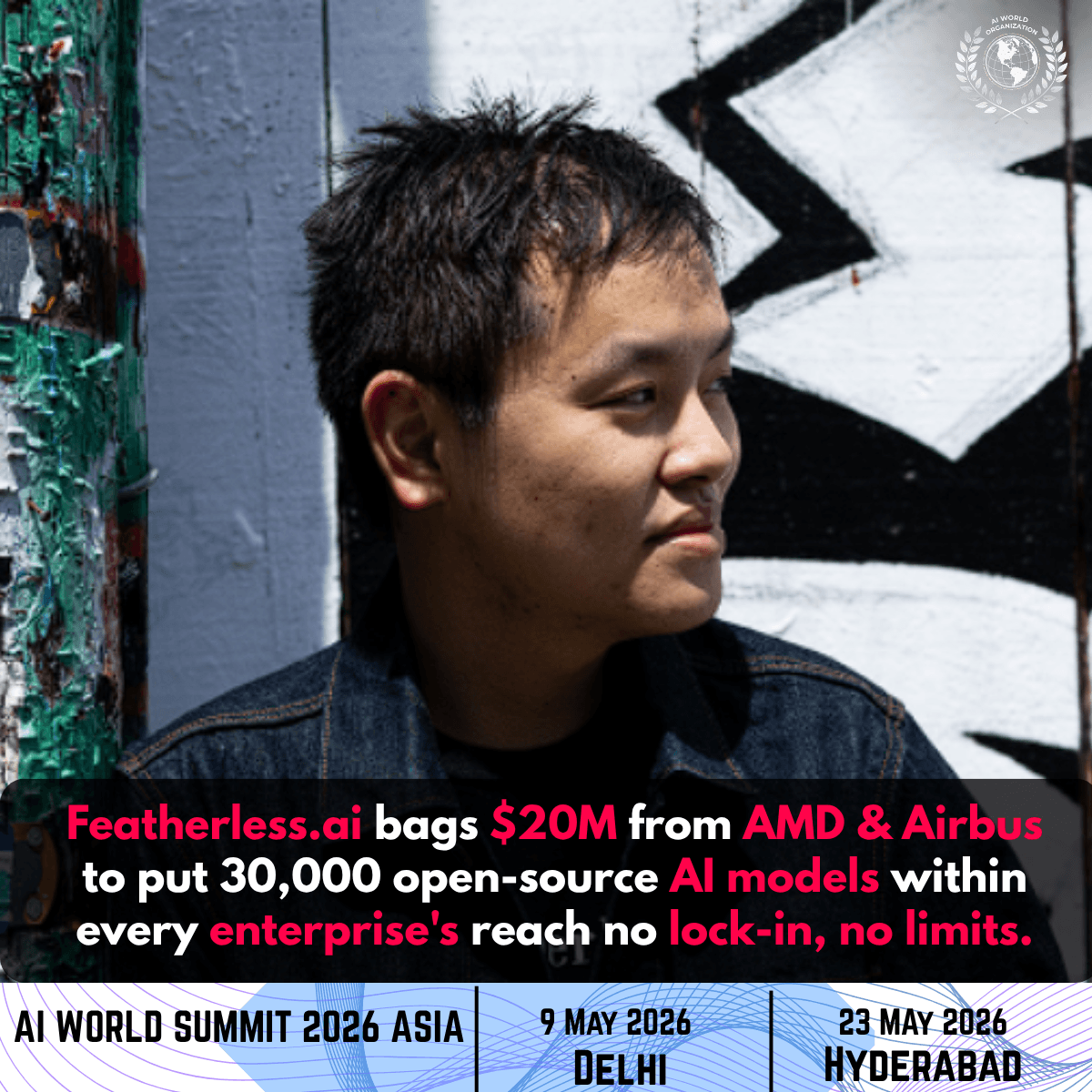
Featherless.ai raises $20M Series A led by AMD and Airbus Ventures to democratize open-source AI model access with serverless inference for global enterprises.
TL;DR
Featherless.ai has raised $20 million in a Series A round backed by AMD Ventures and Airbus Ventures to scale its serverless AI infrastructure platform. The startup lets businesses access over 30,000 open-weight models at a flat monthly rate — no per-token billing, no vendor lock-in. Its hot-swapping tech loads any model in under five seconds, making specialized open-source AI genuinely affordable for enterprises worldwide.
The open-source AI infrastructure space just received a major vote of confidence. Featherless.ai, a serverless inference platform that has quietly been solving one of the most persistent bottlenecks in AI deployment, has announced it has closed a $20 million Series A funding round. The round was co-led by AMD Ventures and Airbus Ventures, two heavyweights from the hardware and aerospace industries respectively, signalling that the push for AI model sovereignty and infrastructure independence is no longer a niche conversation — it is rapidly becoming a boardroom priority. This latest AI funding development reaffirms the growing appetite among enterprise-grade investors to back platforms that break away from vendor lock-in and champion open, scalable AI architecture for developers and businesses worldwide.
Founded in 2023 by Eugene Cheah, Harrison Vanderbyl, and Wesley George, the platform has grown out of a very specific and underserved frustration — the fact that while the AI research community has produced tens of thousands of specialized open-weight models available on platforms like Hugging Face, accessing those models in real production environments has remained prohibitively difficult and expensive. Featherless.ai was built to fix precisely that gap, and with this fresh AI funding news making waves across the global tech community, the startup looks set to expand its reach significantly in the months ahead.
What Featherless.ai Is Really Building — And Why It Matters
To understand why this round of AI funding is generating so much attention, it helps to understand the structural problem that Featherless.ai is trying to solve. Hugging Face, the widely-celebrated repository for machine learning models, currently hosts well over 30,000 open-weight AI models. These are not generic, one-size-fits-all tools — many are highly specialized, trained for specific languages, regional dialects, professional domains, industry-specific tasks, or niche use cases that the flagship commercial models from companies like OpenAI and Anthropic simply do not handle well. The problem, however, is that while these models exist, deploying them in a consistent and cost-effective production environment has historically been a nightmare.
For most businesses, accessing even a handful of these specialized models would require renting thousands of dollars' worth of GPU compute on a continuous basis — an approach that makes economic sense only for the largest organizations. For smaller enterprises, startups operating in regional markets, public sector bodies, or research institutions, the cost alone made it impossible to seriously consider deploying open-weight AI at scale. Wesley George, one of the co-founders of Featherless.ai, described the problem with clarity: "Typically, the models available from providers are only the most popular ones. Accessing models trained on more niche areas is very difficult. Making those available continuously online, at a price where you don't have to rent thousands of dollars of compute to have a conversation with a chatbot that can speak your language — that's the genesis of Featherless."
This is where Featherless.ai's core technical innovation comes into play. The platform has developed a proprietary hot-swapping technique that dynamically loads AI models into GPU memory on demand in under five seconds and then releases them when they are no longer in use. This seemingly simple concept has a profound impact on the economics of open model deployment. Instead of dedicating fixed hardware to each model at all times — the approach used by almost every competing platform — Featherless runs its entire catalogue of 30,000 models from a shared, continuously optimized pool of GPU resources. The result is a flat-rate pricing model that offers businesses fixed monthly capacity rather than the variable, often unpredictable per-token billing that dominates the current market.
How Featherless.ai Stands Apart from Competitors in the AI Infrastructure Space
The AI inference and open model hosting market is becoming increasingly competitive. Platforms like Together AI, Replicate, and Baseten have all built meaningful businesses around providing API access to open-weight models. Groq has carved out a reputation for ultra-fast inference on its proprietary Language Processing Units. But Featherless.ai's team believes none of these platforms are truly neutral — and that lack of neutrality is a growing problem for enterprise customers who want real independence.
Each of the major competing platforms comes with some form of implicit alignment, whether through hardware preferences, exclusive model partnerships, or deep integration with specific cloud ecosystems. These alignments recreate the very vendor dependencies that businesses are increasingly trying to escape. Featherless, by contrast, positions itself as hardware-agnostic and model-neutral. Its goal is not to push any particular model or cloud stack, but to make the entire open-model ecosystem equally accessible and equally performant regardless of the underlying infrastructure.
George was direct about the competitive differentiation: "Most inference providers have 50 to 100 models available in their public cloud. We have the entire catalogue of 30,000 models available online. You can't run 30,000 models by dedicating $2,000 of hardware to each one. That's what our competitors do. That's the differentiation." For enterprise buyers, this translates into something genuinely new — the ability to deploy highly specialized AI models without worrying about spiralling compute costs or being steered toward specific vendor ecosystems. The cost predictability that comes with Featherless's flat-rate model is particularly valuable for organizations running multiple niche models simultaneously, something that would be economically unviable on any per-token billing system.
The AI World Organisation has been closely tracking this segment of the AI funding landscape, and this particular round stands out not just for its size but for the quality and strategic significance of its backers. It reflects a broader market recognition that the next frontier of AI adoption will not be won by whoever builds the most powerful flagship model — it will be won by whoever makes the widest range of AI capabilities genuinely accessible and deployable at scale.
Why AMD and Airbus Are the Ideal Backers for This Vision
The investor lineup for this AI funding round is not incidental — it is deeply strategic, and each participant brings something specific to the table. AMD Ventures, the corporate venture arm of the semiconductor giant Advanced Micro Devices, has a clear and direct interest in Featherless.ai's success. One of the core commitments that Featherless has made is ensuring that the most widely used open-weight AI models run natively and efficiently on AMD's ROCm software platform, which is the company's primary alternative to NVIDIA's dominant CUDA ecosystem.
This matters enormously in the context of the AI hardware market. NVIDIA currently controls the overwhelming majority of the GPU compute market that powers modern AI workloads, and its CUDA platform has become so deeply embedded in the AI development workflow that most frameworks, models, and tools are effectively optimized for NVIDIA hardware first and everything else second. AMD has been working for years to close this gap with ROCm, but developer adoption has been slow partly because so little AI infrastructure is built to run seamlessly on AMD GPUs. Featherless's commitment to native ROCm support gives developers and enterprises a practical, production-ready reason to consider AMD hardware — and that is exactly the kind of ecosystem leverage that AMD Ventures is looking to build.
George articulated this alignment succinctly: "AMD knows we can do great things with their hardware. They're very committed to open source. There's a very natural fit." For Airbus Ventures, which had already backed the company at the seed stage, the focus is different but equally strategic. The aerospace giant has been investing in open-weight AI deployment for enterprise environments, and the theme of data sovereignty — the idea that organizations should control their own AI models and the infrastructure they run on — resonates strongly with the regulatory and security requirements that define industries like aerospace, defence, and advanced manufacturing. The broader investor syndicate also includes BMW i Ventures, Kickstart Ventures, Panache Ventures, and Wavemaker Ventures, bringing a mix of mobility, corporate, and generalist venture capital into the fold.
The Sovereignty Angle: AI Funding News That Reflects a Global Shift
Perhaps the most significant dimension of this AI funding news is what it says about where enterprise AI adoption is heading globally. For the past few years, the conversation around open-source AI was largely centred on capability — the question of whether open models could match the performance of proprietary systems like GPT-4 or Claude. That debate has essentially been settled. Today, open-weight models are genuinely capable of handling complex, production-grade workloads across a wide range of domains, and the gap with closed models continues to narrow.
As a result, the centre of gravity in enterprise AI discussions has shifted dramatically. The new question is no longer whether open models are good enough — it is about who controls them, where they run, and what happens to an organization's data and decision-making capability when those models are hosted by a third party in a foreign jurisdiction. This is particularly acute for companies and government bodies outside the United States, where concerns about data sovereignty, national security, and strategic autonomy are increasingly shaping procurement decisions around AI.
George addressed this shift with notable candour: "A year ago, there was still a question of whether open models would be intelligent enough to do productive work. Today, that's no longer the case. The focus is now shifting to who controls the AI, especially in markets outside the US, where there is a big push to control your models, your infrastructure, and the freedom to take whatever you've built wherever you want." This framing positions Featherless not merely as an infrastructure company but as an enabler of AI independence — a platform that gives organizations in every part of the world the practical ability to deploy, own, and control their AI systems on their own terms.
The AI World Organisation sees this development as one of the most meaningful recent signals in the global AI funding ecosystem. The $20 million round is not just capital — it is a validation of a model of AI infrastructure that is neutral, open, and globally accessible. The participation of corporations from the semiconductor, aerospace, and automotive industries also points to a broadening of the AI investor base, beyond traditional venture capital toward strategic corporate players who see open AI infrastructure as critical to their own long-term competitive positioning.
What Comes Next for Featherless.ai
With $20 million in fresh AI funding now secured, Featherless.ai has outlined a clear set of priorities for the next phase of its development. The company plans to aggressively expand its infrastructure footprint into new geographic regions, which will be essential for serving enterprise customers who require their AI workloads to remain within specific jurisdictions for regulatory or data sovereignty reasons. Building out regional infrastructure is both a technical and a commercial necessity for a platform that is fundamentally positioning itself as the neutral, global alternative to US-centric AI cloud providers.
In parallel, Featherless.ai intends to develop a marketplace for specialized open-weight models — a move that could significantly accelerate the discovery and deployment of niche AI models for industry-specific applications. At the moment, finding the right open model for a particular use case requires deep familiarity with the research community and platforms like Hugging Face. A curated marketplace built around Featherless's serverless infrastructure could dramatically lower that barrier, making it far easier for enterprises to identify, evaluate, and deploy the exact model they need without any of the infrastructure complexity that currently makes that process so difficult.
The company also plans to deepen its integrations with hardware architectures beyond NVIDIA's dominant platform, reinforcing its commitment to neutrality and ensuring that enterprises have genuine choice in how they build and run their AI systems. As AI funding news continues to flow at a rapid pace across the global technology landscape, Featherless.ai represents a particularly interesting story — not because it is chasing the biggest models or the most attention-grabbing benchmarks, but because it is quietly solving the infrastructure problem that will determine whether the promise of open-source AI actually becomes a reality for the majority of organizations around the world.
The AI World Organisation will continue to track the progress of Featherless.ai and other key players in the open-source AI infrastructure space, as this segment of the market looks increasingly likely to shape the next chapter of enterprise AI adoption globally.