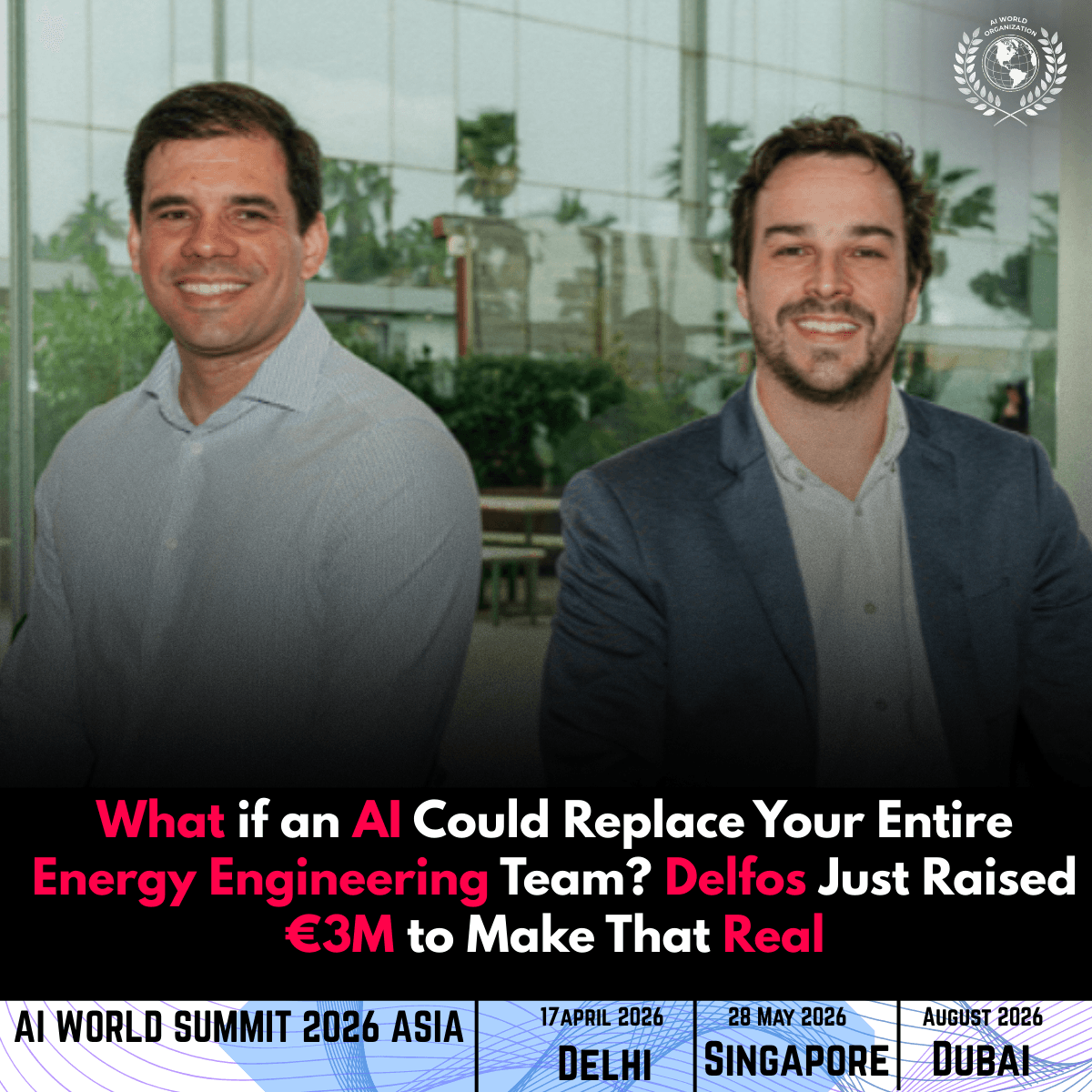
Delfos Energy Raises €3M to Scale AI Virtual Engineer
Delfos Energy secures €3M seed extension to deploy its AI virtual engineer across 1,000+ renewable energy sites in 10+ countries ahead of Series A.
TL;DR
Barcelona-based Delfos Energy has raised €3M in a seed extension to expand its AI-powered "virtual engineer" platform across 1,000+ renewable energy sites in 10+ countries. The platform helps energy teams monitor assets, detect faults early, and take action — all without needing an on-site expert. With battery storage and a US expansion next on the roadmap, a Series A is expected within 12–18 months.
Delfos Energy Secures €3M Seed Extension to Deploy AI-Powered Virtual Engineer Across 1,000+ Renewable Energy Sites
The renewable energy sector is undergoing one of its most consequential transformations in decades — and yet, the workforce responsible for managing that transformation is shrinking. Engineers are retiring faster than they can be replaced, and energy portfolios are becoming increasingly complex with the addition of wind farms, solar installations, and battery storage systems scattered across multiple geographies. Into this growing operational void steps Delfos Energy, a Barcelona-based AI startup that has developed what it calls a "virtual engineer" — an intelligent platform designed to monitor, diagnose, and guide decisions across distributed energy assets in real time. The company has just announced a €3 million seed extension round, marking a significant milestone in its journey toward a full Series A and global expansion. This development is a standout moment in recent AI funding news and highlights the accelerating convergence of artificial intelligence with clean energy infrastructure.
The latest round was led by Vox Capital and COPEL, joining a growing roster of backers that already includes Headline, Contrarian Ventures, DOMO VC, and EDP Ventures. The infusion of capital is not just a financial boost — it represents a strong vote of confidence from some of Europe's most forward-thinking energy and technology investors in the premise that AI can fundamentally reshape how renewable energy fleets are operated, maintained, and optimised. At The AI World Organisation, where we actively track the most impactful movements across the global AI ecosystem, this round stands as a powerful indicator of where AI funding is heading in the clean energy domain.
The Problem No Dashboard Could Ever Solve
To understand why Delfos Energy is gaining traction so rapidly, it helps to understand the fundamental challenge it was built to address. The energy transition in Europe and beyond has been extraordinarily ambitious in its targets — wind and solar capacity has scaled dramatically over the past decade, and battery storage is poised to follow a similar curve. But infrastructure growth is only half the equation. The other half is operations: making sure these assets are running efficiently, catching failures before they spiral into costly downtime, and ensuring maintenance teams know exactly what to do, when to do it, and why.
Traditional monitoring tools — dashboards, alert systems, SCADA platforms — were designed for a simpler era. They tell operators what is happening, but they stop short of telling operators what to do about it. Alerts flood in without prioritisation. Signals arrive without context. A team of three engineers might be responsible for monitoring hundreds of turbines or solar installations across multiple time zones, and the sheer volume of data generates more confusion than clarity. When experienced engineers retire, they take decades of intuitive domain knowledge with them — knowledge that no standard software platform has ever been able to preserve or scale.
This is the gap that Delfos was founded to close. Rather than building yet another dashboard, the company set out to build the intelligence layer that sits above the data and makes sense of it — in human terms, in real time, with context-aware recommendations that a non-specialist can act upon. The result is an AI platform that doesn't just report anomalies; it explains what they mean, ranks them by urgency, and tells teams precisely what to do next. And it does so through interfaces as accessible as WhatsApp, making expert-level insight available to field crews anywhere in the world.
From a Presentation in Norway to a Platform Powering 1,000 Sites
The origin story of Delfos Energy is one of those rare instances where a single moment of clarity sets an entire career in motion. CEO and co-founder Guilherme Studart, who built the company alongside co-founder Samuel Lima in Barcelona in 2017, traces the genesis of the idea back to a presentation he attended while completing the final month of his master's degree in Norway. A senior leader from one of Norway's major utilities stood before a room and mapped out the regions of the world where renewable energy expansion was about to explode — with wind and, even more significantly, solar at the forefront of that surge.
For Studart, that presentation was a turning point. Rather than entering the traditional engineering job market, he asked himself a different question: why not build something that directly addresses the operational challenges that such a massive energy expansion would inevitably create? That question became the foundation of Delfos, and nearly a decade later, the platform is being deployed across more than 1,000 sites in over 10 countries, with Europe alone accounting for 35 to 40 percent of the company's revenue.
The platform's architecture reflects the dual expertise that Studart and Lima brought to the venture — deep machine learning capability combined with genuine, ground-level energy domain knowledge. Under the hood, Delfos runs its own proprietary ML engine that handles real-time performance monitoring and reliability analysis, processing data streams from turbines, inverters, sensors, and grid connections to detect anomalies and identify early signs of failure before they become outages. Sitting above this ML layer is a workflow AI system that handles the higher-order tasks: generating reports, building maintenance schedules, responding to operator questions in natural language, and producing prioritised action plans that explain not just what is broken but what to do about it and why. This two-layer architecture is what makes Delfos fundamentally different from monitoring tools that simply aggregate and display data — it closes the loop between insight and action in a way that genuinely mimics the reasoning process of an experienced engineer.
Why AI Funding is Flowing Into the Energy Sector's Intelligence Gap
The €3 million seed extension that Delfos has secured is part of a much broader trend in AI funding news that The AI World Organisation has been closely tracking: the accelerating flow of venture capital into AI platforms targeting industrial and infrastructure verticals where the cost of operational failure is enormous and the shortage of skilled labour is only getting worse. Energy is one of the most compelling of these verticals, precisely because the stakes are so high and the traditional tools are so demonstrably inadequate.
What makes this particular AI funding round notable is the quality and strategic alignment of the investors involved. Vox Capital and COPEL bring not just financial resources but direct industry connections and market access — COPEL in particular, as a major Brazilian utility, signals that Delfos is building credibility with operating companies, not just financial sponsors. Meanwhile, the continued participation of Contrarian Ventures, Headline, DOMO VC, and EDP Ventures demonstrates that early backers remain fully committed to the company's trajectory, a sign that the platform is delivering measurable results in the field.
From an industry competitive standpoint, Delfos occupies a distinctly focused position. While players like UptimeAI and Sensemore have built AI monitoring capabilities for manufacturing environments, and companies like Avnet Silica and Orbital Insight operate in hardware-centric or satellite-driven verticals, Delfos has planted its flag exclusively in the energy sector. This is a deliberate strategic choice that pays dividends in the depth of domain-specific intelligence the platform can deliver. Energy systems behave differently from manufacturing lines — the physics of wind and solar generation, the degradation patterns of inverters and turbines, the complex interplay of grid conditions and asset performance — all of these require specialised knowledge that generic industrial AI platforms simply cannot replicate at the same level of nuance. Delfos has spent nearly a decade building that knowledge into its core systems, and that accumulated expertise represents a formidable moat against both established players and new entrants in the AI funding landscape.
Customers are already responding to this depth of capability. According to the company, clients are projecting 4 to 5 times growth as the platform extends its rollout to more than 1,000 sites. That level of expansion confidence from paying customers — not just from investors — is one of the clearest signals that Delfos is delivering genuine operational value, not just a compelling product story.
The Road to Series A: Europe, Battery Storage, and the Autonomous Future
With the seed extension secured, Delfos is moving with purpose toward its next major milestone: a Series A round expected within the next 12 to 18 months. The capital raised in this round will be channelled into two parallel priorities that reflect both the company's immediate commercial opportunities and its longer-term technological vision.
The first priority is European market expansion. Europe is already Delfos' strongest revenue base, and the continent's ongoing energy transition — driven by ambitious climate targets, the accelerating retirement of fossil fuel generation, and the rapid buildout of offshore and onshore wind alongside utility-scale solar — creates an almost ideal commercial environment for a platform designed to make distributed renewable assets more manageable and more profitable. Rolling out to more sites across the 10-plus countries where Delfos already operates will deepen the company's data advantage, strengthen customer relationships, and build the case for the Series A at a time when European energy infrastructure investment is at a historic high.
The second priority is battery energy storage systems, or BESS — and this is where Delfos is making a bet that reflects a sophisticated reading of where the energy transition is heading. As intermittent renewable generation continues to scale, the ability to store and dispatch energy flexibly becomes the critical enabler of a truly clean grid. BESS deployments are accelerating rapidly across Europe, the Americas, and the Asia-Pacific region, but the operational complexity of managing large-scale storage assets is substantial. Degradation monitoring, state-of-health analysis, cycling optimisation, and thermal management are all areas where AI-driven intelligence can add significant value — and where the talent shortage that already plagues wind and solar operations is about to become equally acute. By investing in BESS capabilities now, Delfos is positioning itself at the leading edge of the next wave of energy AI funding and innovation.
Looking further out, the company has articulated a vision that goes beyond even the current platform's sophisticated advisory capabilities. Studart has described the long-term goal as the development of fully autonomous AI agents — systems capable not just of recommending actions but of executing them, handling complex engineering workflows end-to-end without human intervention. This is a genuinely ambitious target, and it reflects the same conviction that drove the founding of Delfos in the first place: that the future of energy operations will be defined by the quality of the intelligence layer sitting above the hardware, not by the hardware itself. The United States is also firmly on the company's post-Series A expansion map, a market where the scale of renewable energy deployment and the intensity of the talent shortage make it a natural next frontier for a platform with Delfos' capabilities.
What Delfos Signals for the Global AI and Energy Landscape
The story of Delfos Energy is instructive beyond its own specifics. It illustrates a pattern that The AI World Organisation sees playing out across multiple sectors: the most durable and impactful AI applications are not those built on top of generic large language models or horizontal automation platforms, but those developed through years of deep domain immersion, where the AI system is trained not just on data but on the practical intuitions and contextual reasoning of genuine subject-matter experts. Delfos spent years building energy-specific intelligence into its platform before it ever talked to investors about scaling. That foundation is why it can offer something that no dashboard company and no generic AI startup can replicate: the reasoning capability of an experienced engineer, available at the scale of a software platform.
The €3 million seed extension is, in that sense, more than a funding announcement. It is a signal that the market is increasingly recognising the value of sector-specific AI intelligence, and that investors with direct operational stakes in clean energy — utilities, climate-focused funds, energy-sector venture firms — are willing to back platforms that can genuinely move the needle on asset performance. As AI funding continues to flow into the intersection of artificial intelligence and energy infrastructure, Delfos represents a compelling model for how that capital can be deployed most effectively: not chasing the broadest possible market, but going deep into a specific operational challenge and building the most intelligent, most contextually aware solution that exists for that challenge anywhere in the world.
For energy operators managing growing portfolios with shrinking teams, for investors looking to back AI companies with genuine competitive differentiation, and for policymakers and industry leaders tracking the technologies that will determine whether Europe's energy transition succeeds at the pace and scale that climate targets demand, Delfos Energy is a name that will increasingly command attention. The virtual engineer is arriving — and it is bringing a decade of real-world knowledge with it.


