CureMeAbroad Raises $600K in AI-Powered Medical Tourism Push
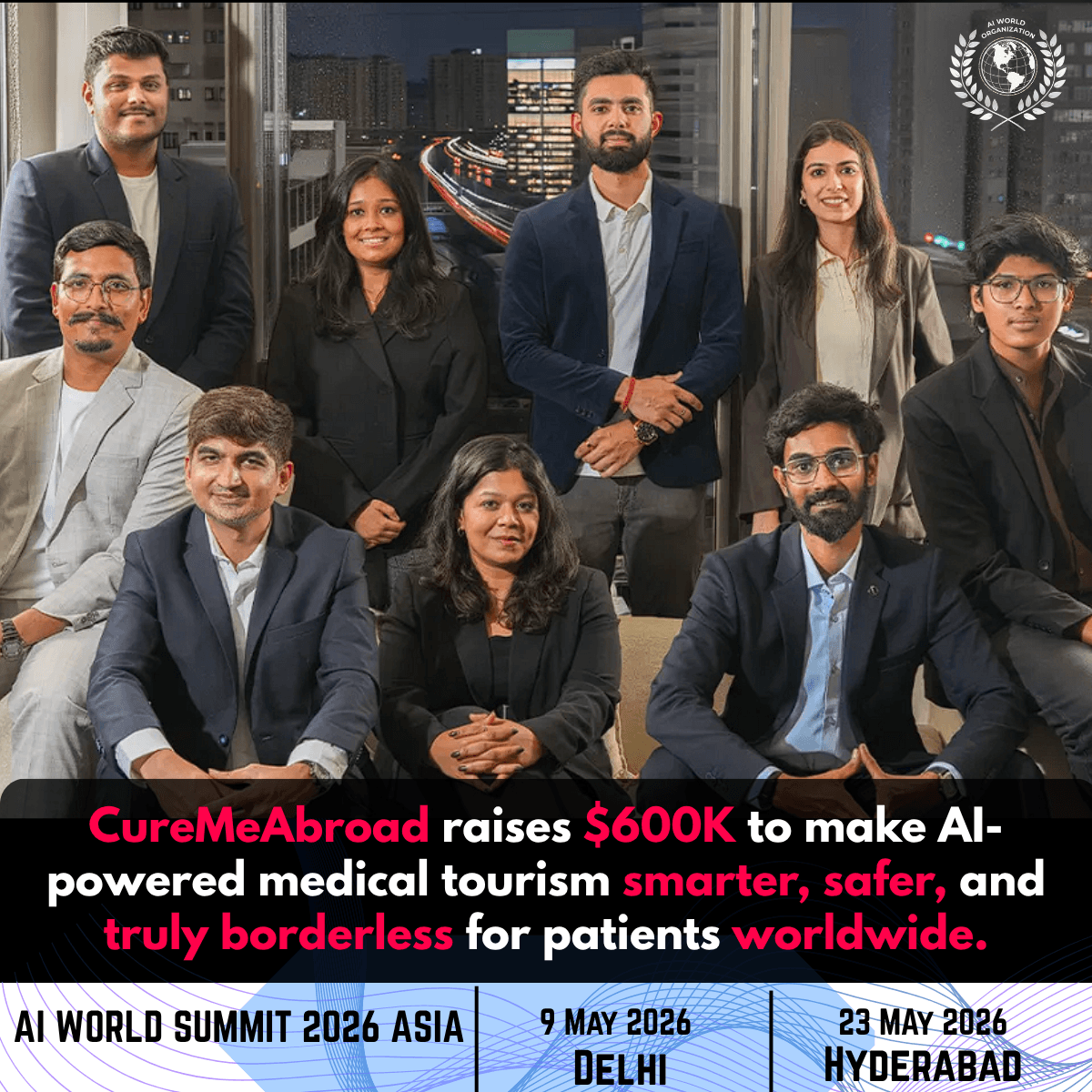
CureMeAbroad secures $600K pre-seed funding to expand its AI-first medical tourism platform across 47 countries and 6,000+ hospitals.
TL;DR
Mumbai-based CureMeAbroad has raised $600K in pre-seed funding to scale its AI-powered medical tourism platform, which helps patients find verified hospitals across 47 countries. With tools like an AI cost estimator and clinical matching models, the startup is tackling transparency gaps in cross-border healthcare — a market projected to hit $174 billion by 2035.
CureMeAbroad Raises $600K in Pre-Seed Funding to Revolutionize AI-Powered Medical Tourism
The global healthcare industry is going through one of its most dramatic transformations in decades — and a good chunk of that disruption is happening not inside hospitals, but in the way patients discover, evaluate, and access them across borders. In a significant piece of AI funding news from the health-tech space, Pune-based medical tourism discovery platform CureMeAbroad has successfully closed a $600,000 pre-seed funding round, drawing backing from a notable group of angel investors. This marks an important early-stage bet on AI's ability to fix one of the most fragmented and trust-deficient sectors in global healthcare.
The round saw participation from prominent names including Roman Saini, Himanshu Ratnoo, Kunal Gupta, Devaiah Bopanna, and Vikrant Potnis — investors whose diverse backgrounds reflect the cross-sectoral potential the startup represents. The AI funding injection will be channelled directly into strengthening CureMeAbroad's core technology stack, scaling its market reach, and solving some deeply entrenched problems that have plagued the medical tourism industry for years.
The Problem CureMeAbroad Is Built to Solve
Anyone who has ever tried to arrange medical treatment abroad knows how overwhelming the process can be. Patients are typically left to navigate a maze of unverified clinic listings, WhatsApp-based agents who work on undisclosed commissions, opaque and wildly inconsistent pricing, and virtually no accountability for post-treatment care. For someone in the UK trying to get a hip replacement in India, or a patient in Africa seeking cardiac surgery in Turkey, the lack of a trustworthy, centralised discovery tool is not just an inconvenience — it can be genuinely dangerous.
CureMeAbroad was built specifically to address this gap. Co-founded in June 2025 by Aditya Oza and Mikhail Bohra — cousins who operate on a foundation of mutual trust — the platform describes itself as functioning like "a knowledgeable medical friend." Rather than pushing patients toward the highest-paying hospital partner, the platform uses technology and verified data to help patients find care that actually suits their specific needs, budget, and health conditions. The founding philosophy was simple but ambitious: bring the trust and transparency of a consumer app into an industry that has historically operated in the shadows.
The startup is HIPAA certified, which means it meets internationally recognised standards for patient data privacy — a critical credential in an industry where sensitive medical records are routinely shared across borders and jurisdictions. This level of compliance, achieved at such an early stage, signals that CureMeAbroad is serious about building infrastructure that can scale globally without compromising patient safety.
How the AI-First Platform Works
What sets CureMeAbroad apart from older-generation medical tourism portals is the depth and sophistication of the artificial intelligence that powers it. At its core, the platform runs a proprietary AI cost estimator that has been trained on over 634 procedure records — a dataset that allows it to generate realistic, data-backed cost projections for patients before they commit to anything. This alone addresses one of the biggest pain points in the industry: the lack of pricing transparency, which often leaves patients blindsided by unexpected bills mid-treatment or after they return home.
Beyond cost estimation, the platform leverages clinical matching models that go well beyond simple keyword matching. When a patient inputs their treatment needs, the system analyses hospital infrastructure quality, surgeon expertise, international accreditations like JCI (Joint Commission International), and AI-driven sentiment analysis of real patient reviews — all to surface the most relevant and reliable options. This degree of nuance is what separates a genuine AI-first platform from one that simply slaps an AI badge on a glorified directory listing.
There is also a multilingual patient intelligence layer built into the discovery engine — a feature that acknowledges the global and diverse nature of the platform's target audience. Medical tourism patients come from dozens of countries, speak different languages, and have widely varying familiarity with healthcare systems. By building multilingual support into the intelligence layer rather than treating it as an afterthought, CureMeAbroad is making a clear statement about the kind of global platform it intends to become. This aspect of the AI funding deployment is particularly important for the company's expansion into the GCC, UK, and African markets — regions with distinct linguistic and cultural healthcare expectations.
Scale, Reach, and the Market Opportunity
The numbers behind CureMeAbroad's current footprint are impressive for a company that is less than a year old. The platform already hosts a directory of over 6,000 hospitals across 47 countries and 45 medical specialties, and has formed partnerships with more than 380 accredited hospitals across key medical tourism destinations including Mexico, Turkey, Thailand, India, and Georgia. These are not random listings — they are verified, accredited facilities that meet the platform's quality benchmarks.
The market CureMeAbroad is targeting is genuinely massive and growing fast. According to data from GM Insights, the global medical tourism market is projected to grow from $84.5 billion in 2026 to $174.1 billion by 2035, at a compound annual growth rate of 8.4%. Other estimates put the figure even higher — Grand View Research pegs the 2035 market size at $126.2 billion, growing at a CAGR of 14.1%, while Research Nester estimates figures as high as $316.7 billion by that year. Even at the more conservative end, the size of the opportunity makes it clear why investors are paying attention to platforms that can credibly claim an early-mover advantage in digitalising this space.
CureMeAbroad currently competes with established names in the sector such as Bookimed, PlacidWay, The Medical Tourism Company, and Medical Departures. However, the competitive distinction the startup is banking on is its AI-native architecture. While existing platforms function largely as listing aggregators, CureMeAbroad is positioning itself as an intelligent discovery engine — one that learns from patient behaviour and procedure data to deliver increasingly personalised and accurate recommendations over time. This is the kind of differentiation that could prove decisive in a market where trust is everything and the margin for error — quite literally — can be a patient's health.
What the Fresh Capital Will Fund
The $600K raised in this pre-seed round is earmarked for a combination of technology upgrades, team expansion, and geographic scaling. On the technology side, the company plans to deepen the capabilities of its AI cost estimator, improve the accuracy of its clinical matching models, and extend the reach of its multilingual intelligence layer. These are the three pillars that determine how well the platform performs for a patient sitting in Lagos trying to find an affordable oncologist in Chennai — and getting them right will be the difference between a tool people recommend and one they abandon after a single frustrating search.
On the market expansion side, the company is eyeing GCC (Gulf Cooperation Council) nations, the United Kingdom, and African markets as its primary source markets. These are regions with large populations of patients who are either priced out of local healthcare or lack access to certain specialties domestically, and who are therefore strong candidates for cross-border treatment. Hiring will also be a priority, with plans to grow across product development, clinical operations, and international partnerships. The strategic intent is clear: establish a strong foothold in high-intent source markets before competitors can replicate the AI-first discovery model.
This is exactly the kind of early-stage AI funding news that signals where the future of health-tech is headed. The combination of a large and growing market, a real and well-documented problem, and a technology-native solution gives CureMeAbroad the kind of foundation that early investors look for when placing pre-seed bets. The participation of high-profile angel investors — including Roman Saini, who is well-known in India's edtech and social impact ecosystem — adds further credibility to the company's early narrative.
AI World's Take: Why This Matters for the Broader AI Ecosystem
At The AI World Organisation, we track AI funding developments across sectors — and CureMeAbroad's raise is a compelling example of AI being deployed not as a marketing feature, but as genuine operational infrastructure. The startup is not using AI to generate chatbot responses or automate emails. It is using it to solve a problem that has real human stakes: helping patients in vulnerable moments make better, safer, and more informed decisions about where to seek care.
The fact that this level of AI sophistication — a HIPAA-certified platform with a trained cost estimator, clinical matching models, and multilingual intelligence — has been built by a sub-one-year-old startup speaks volumes about how quickly AI tooling has matured. The barriers to building AI-native products have dropped substantially, and founders who deeply understand domain-specific problems are now able to deploy machine learning in ways that would have required far larger teams and budgets just a few years ago.
What CureMeAbroad is doing in medical tourism mirrors what we're seeing in legal tech, financial services, and education — AI being used to close information asymmetry gaps that have long benefited intermediaries at the expense of end users. Whether it's a patient in Nairobi trying to understand what a knee replacement costs in Istanbul, or a family in Manchester researching cancer treatment options in India, the platform's vision of AI-powered transparency in healthcare discovery is both timely and genuinely consequential. The AI funding news around this startup deserves attention not just from health-tech watchers, but from anyone tracking how artificial intelligence is reshaping access to critical human services.