Axiamatic Bags $54M to Fix Enterprise AI Transformation
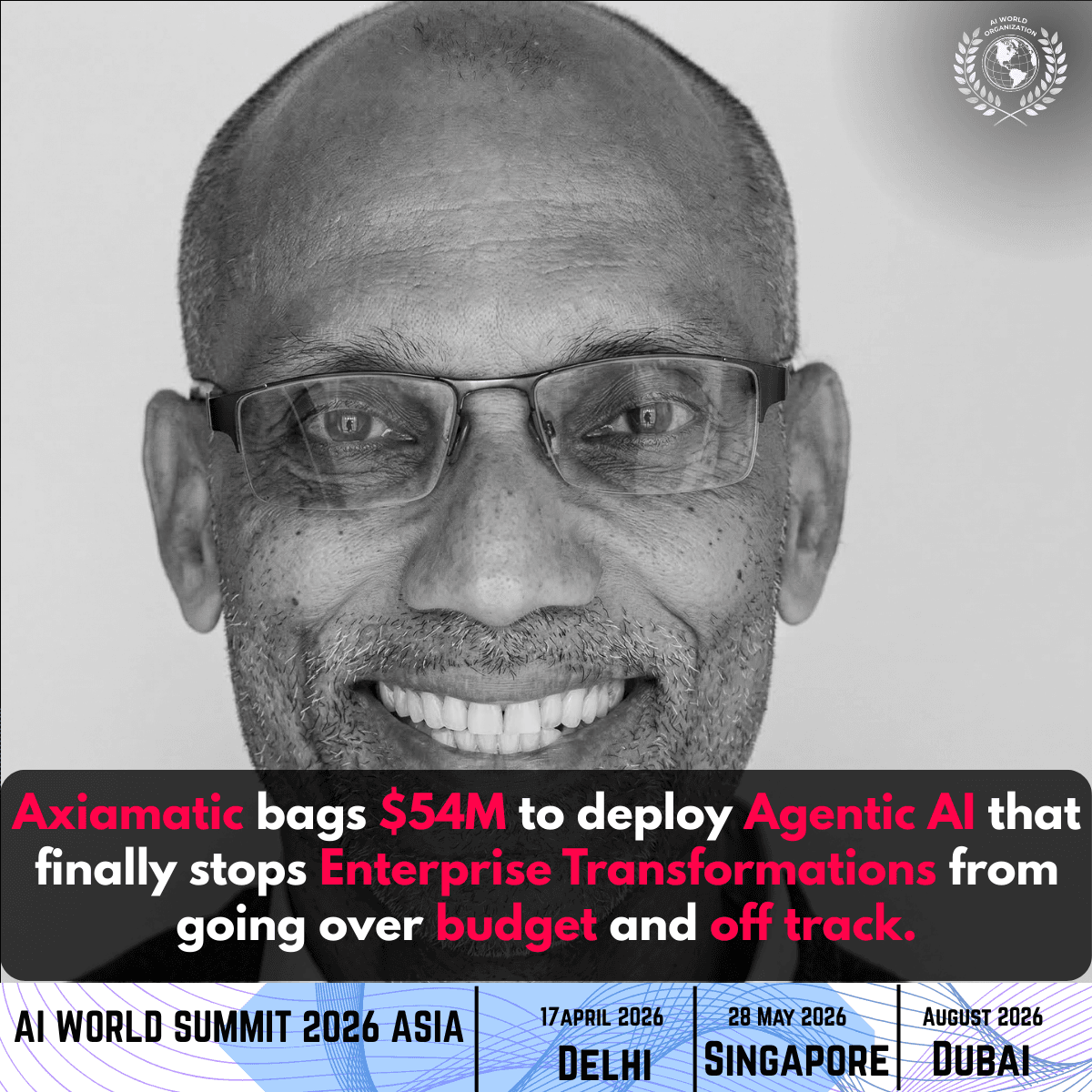
Axiamatic raises $54M in AI funding from Greylock and Bessemer to deploy agentic AI for enterprise transformation programs. Here's what makes it a game-changer.
TL;DR
Axiamatic, a San Francisco-based startup, has raised $54M in AI funding from Greylock and Bessemer to tackle one of enterprise's oldest problems transformation failures. Its agentic AI platform monitors live programs across 250+ systems, flags risks early, and has already saved Fortune 500 clients from massive cost and schedule overruns.
Axiamatic Raises $54M from Greylock and Bessemer to Revolutionise AI-Driven Enterprise Transformations
Enterprise transformation has always been a colossal undertaking. Whether it is a company-wide ERP overhaul, a CRM consolidation, or a large-scale supply chain migration, these programs are notorious for one thing — going terribly wrong. They run over budget, extend beyond planned timelines, and frequently fall short of the business outcomes they were supposed to deliver in the first place. For large enterprises managing multiple simultaneous transformation streams, the cost and complexity of keeping everything on track has only grown more unmanageable over time. Despite decades of investment in project management methodologies and consulting frameworks, failure rates in enterprise transformation programs remain alarmingly high. It is against this backdrop that a San Francisco-based startup called Axiamatic has stepped into the spotlight with a bold proposition: artificial intelligence, purpose-built for the complexity of enterprise transformation, can finally fix what humans alone have failed to solve. In what is shaping up to be one of the most noteworthy pieces of AI funding news to emerge from the enterprise software space this year, Axiamatic has come out of stealth mode with a $54 million funding round backed by two of Silicon Valley's most prestigious venture capital firms — Greylock Partners and Bessemer Venture Partners. This landmark raise is a clear signal that institutional investors are increasingly placing their bets on agentic AI platforms that go beyond productivity tools and tackle deeply operational, high-stakes business challenges.
The Enterprise Transformation Crisis That AI Must Solve
To fully appreciate what Axiamatic is building and why this round of AI funding carries such significance, it is important to understand just how broken the enterprise transformation landscape has been for decades. Studies across industries have consistently shown that upwards of 70 percent of large-scale transformation initiatives either fail outright or fail to deliver their intended value. These are not small projects — they are multi-year programs involving hundreds of stakeholders, dozens of workstreams, massive technology deployments, and billions of dollars in cumulative investment globally. The traditional response to this problem has been to throw more human resources at it. Companies hire armies of program managers, change management consultants, and system integration specialists, hoping that more boots on the ground will somehow tame the chaos. But as programs grow more complex, involve more systems, and require tighter cross-functional coordination, that human-centric model has increasingly shown its limits.
The problem is not a lack of talent or effort. It is a fundamental information and coordination problem. Decision-makers at the top rarely have accurate, real-time visibility into what is happening at the workstream level. By the time risks surface to leadership, they have often already snowballed into crises. Context is lost when team members rotate in and out. Stakeholders receive inconsistent information. Change resistance builds silently until it erupts as a project-stopping barrier. No human team, regardless of size or expertise, can continuously monitor thousands of signals across a sprawling transformation program in real time. This is precisely the gap that Axiamatic was founded to close — and it is doing so with an agentic AI platform that operates at a scale and speed no human organisation can match.
Founders with Two Decades of Enterprise Software DNA
What gives Axiamatic its credibility is not just the scale of its AI funding or the prestige of its backers — it is the depth of enterprise software experience that its founders bring to the table. Axiamatic was co-founded by Rajiv Gupta and Kaushik Narayan, two entrepreneurs who have spent more than twenty years working together in the enterprise software space. Their long track record of building and scaling enterprise software solutions means they understand the operational realities of large transformation programs from the inside — not just as observers or consultants, but as builders who have seen firsthand what breaks down and why.
The idea for Axiamatic emerged from extensive conversations with enterprise leaders across industries, all of whom described facing the same fundamental pain points. Whether they were running a pharmaceutical giant through an ERP modernisation or helping a consumer goods company consolidate its CRM systems, the story was the same — too much complexity, too little visibility, and too many costly surprises. Rajiv Gupta articulated the founding insight behind Axiamatic clearly when he said, "The traditional answer to managing enterprise transformations has been to hire an army of program managers, change managers, and consultants, yet the complexity of executing large programs has grown far beyond what any human team can effectively manage." He went on to add, "We built Axiamatic to overturn the fate of enterprise transformations. For the first time, enterprises and SIs have an AI platform purpose-built to supercharge every team and deliver successful transformations at an accelerated pace." This vision of not just augmenting human teams but fundamentally changing the outcome trajectory of transformation programs is what has attracted the attention of the venture community and made this one of the most talked-about AI funding news stories in the enterprise technology sector.
Inside the Axiamatic Platform: Agentic AI at the Core of Enterprise Change
At the heart of Axiamatic's value proposition is a sophisticated agentic AI platform that is built from the ground up for the unique demands of enterprise transformation management. Unlike generic AI productivity tools or broad-purpose copilots, Axiamatic's platform is laser-focused on the operational intelligence layer that transformation programs desperately need. The platform integrates with more than 250 enterprise systems, meaning it can connect to the full ecosystem of tools that a large organisation typically uses — from project tracking systems and document repositories to HR platforms, ERP systems, and financial management tools.
Once connected, the platform continuously ingests signals from across the entire transformation program. It does not rely on periodic status updates or manually prepared reports. Instead, it processes real-time data flows to construct what Axiamatic calls a live digital twin of the transformation program. This digital twin is a dynamic, always-current representation of the program's status — capturing workstream progress, stakeholder alignment, resource allocation, risk indicators, and change adoption signals all in one unified model. The concept of a digital twin has long been applied in manufacturing and infrastructure, but applying it to the management of enterprise change programs is a genuinely novel approach that reflects the creative thinking behind Axiamatic's product architecture.
Once the digital twin is established and continuously updated, the platform deploys autonomous AI agents to monitor it around the clock. These agents are trained to detect early warning signs that human program managers might miss or catch too late. This includes workstream drift — where a particular initiative begins to deviate from its planned trajectory — context loss, where the accumulated knowledge and rationale behind decisions begins to erode as team members change, and resistance to change, where adoption of new systems or processes is lagging in ways that could derail the overall transformation. When the agents identify these signals, they do not simply log them in a dashboard that someone might check days later. Instead, they surface the insights directly to the relevant stakeholders through the communication platforms those people already use in their daily work — namely Slack and Microsoft Teams. This means that instead of requiring program teams to learn a new interface or log into a separate system, Axiamatic brings the intelligence to where the work is already happening.
Adding another layer of operational support, the platform also provides each stakeholder with a role-specific AI assistant. A project manager sees insights and recommendations tailored to their workstreams. A CIO gets a strategic overview with risk-adjusted scenarios. A change manager receives adoption metrics and guidance on where interventions are most urgently needed. These assistants can generate briefs, answer questions about the program's current status, and even take instructions through voice or chat interfaces — making the AI layer genuinely useful across roles and levels of technical sophistication.
Proven Results with Fortune 500 Customers Across Industries
Axiamatic's emergence from stealth is not just backed by compelling technology and impressive AI funding — it is grounded in real-world results delivered to some of the world's largest enterprises. The company reports strong early adoption among Fortune 500 clients spanning Life Sciences, Consumer Packaged Goods, and High Tech. Among its reference customers are Heico and Marmon, both large and complex enterprise organisations that run significant transformation programs as a matter of ongoing business operations. These customers have used Axiamatic's platform across a wide range of transformation types, including ERP modernisations, CRM consolidations, Supply Chain transformations, and Source-to-Pay migrations — covering essentially the full spectrum of major enterprise change programs.
One of the most striking data points from Axiamatic's early deployments is the financial and timeline impact the platform has demonstrated. During a single 18-month ERP transformation program, Axiamatic's platform was credited with preventing a 50 percent cost overrun and a 40 percent schedule overrun for a customer. To put that in context, consider that a large ERP transformation can easily run into tens or even hundreds of millions of dollars. A 50 percent cost overrun on a program of that scale represents a truly enormous financial exposure — one that Axiamatic's continuous risk monitoring and early intervention capabilities helped the customer avoid entirely. This kind of concrete, quantifiable value creation is exactly what enterprise buyers look for when evaluating new technology investments, and it is what makes this AI funding news particularly noteworthy for anyone tracking the intersection of agentic AI and enterprise operations.
The breadth of industries and transformation types that Axiamatic has already served speaks to the platform's versatility. Unlike point solutions that address a narrow slice of the transformation challenge, Axiamatic's architecture is designed to work across any type of large program. This makes it applicable to virtually every major enterprise on the planet, all of which are continuously running some form of transformation initiative — whether driven by technology modernisation, regulatory change, market disruption, or strategic repositioning.
Investor Confidence and the Broader AI Funding Landscape
The $54 million backing from Greylock Partners and Bessemer Venture Partners is a strong endorsement of Axiamatic's vision, but it also reflects a broader trend in the AI funding news cycle: enterprise-focused AI companies are attracting serious capital because their value propositions are clear, their addressable markets are massive, and their ability to demonstrate ROI is far more straightforward than consumer AI applications. Greylock Partners and Bessemer Venture Partners are not just financial backers — they are strategic partners with deep networks in the enterprise technology ecosystem. Their involvement gives Axiamatic access to relationships, market insights, and go-to-market support that can accelerate its growth significantly.
Mike Droesch, Partner at Bessemer Venture Partners, captured the investor thesis succinctly: "Enterprise transformations are one of the largest budget items for most CIOs and still one of their biggest headaches. Our thesis is that AI will fundamentally transform these labour-intensive processes. Axiamatic is building the intelligence and context layer that enables enterprises to apply AI in accelerating these transformations." Droesch's framing highlights something important — this is not AI for AI's sake. This is AI applied to a specific, high-value business problem that every large enterprise faces and that represents one of the most significant sources of value creation or value destruction in the corporate world. The fact that this is framed as category-defining enterprise software underscores the ambition behind both the product and the AI funding that supports it.
The current environment for AI funding in the enterprise software space is extraordinarily active. Investors across the venture landscape are doubling down on agentic AI platforms that can demonstrate measurable impact on core business operations. Axiamatic fits squarely into this investment thesis — it is not a tool that sits on the periphery of enterprise workflows, but one that embeds itself into the critical path of some of the most consequential programs a business will ever undertake. As more enterprises begin to grapple seriously with the challenge of AI-driven transformation, platforms like Axiamatic that can manage and accelerate those transformations intelligently are poised to become indispensable infrastructure for the modern enterprise.
What This Means for the Global AI Ecosystem
From the perspective of the global AI community, Axiamatic's $54 million raise and stealth exit is a meaningful data point in a rapidly evolving landscape. The AI World Organisation, which brings together over 5,000 AI leaders across APAC, Europe, and the Americas, has consistently highlighted enterprise AI deployment as one of the most critical frontiers in the current phase of artificial intelligence development. The challenge is no longer whether AI is capable of delivering enterprise value — it demonstrably is. The challenge is deploying it with the specificity, reliability, and contextual intelligence required to handle the complexity of real-world enterprise environments.
Axiamatic's approach — building a dedicated AI operating layer for transformation programs, rather than attempting to retrofit a general-purpose AI tool — reflects exactly the kind of domain-specific, problem-first AI development philosophy that tends to produce the most durable enterprise software companies. As global enterprises accelerate their own transformation agendas in response to AI disruption across their industries, the demand for platforms that can manage those transformations intelligently is only going to grow. The AI funding news surrounding Axiamatic's raise is therefore not just a story about one startup — it is a signal of where the enterprise AI investment landscape is heading and what kinds of solutions are most urgently needed by the organisations undertaking the hardest work of modernisation and change.
The AI World Organisation will continue to monitor and spotlight investments, innovations, and leadership stories shaping the global AI ecosystem. Axiamatic's emergence from stealth marks the beginning of what promises to be a compelling journey — one worth following closely for anyone invested in the future of enterprise AI.