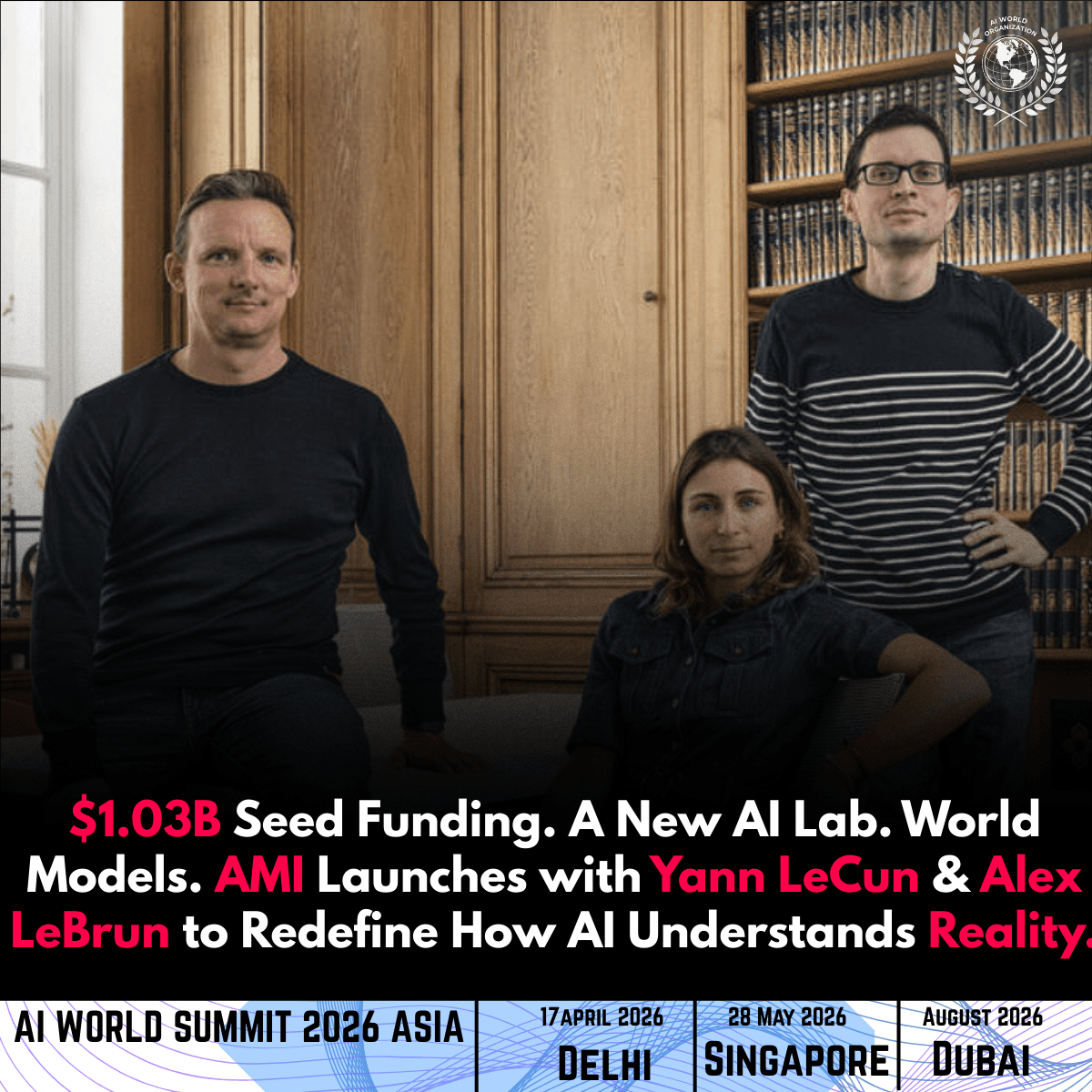
AMI Raises $1.03B: Alex LeBrun Named CEO
AMI launches with $1.03B seed funding, appointing Alex LeBrun as CEO to build world models that move beyond generative AI into real-world intelligence.
TL;DR
AMI, a brand-new frontier AI research lab, has officially launched with a record-breaking $1.03 billion in seed funding. Alex LeBrun, former CEO of healthcare AI company Nabla, steps in as CEO, while renowned AI pioneer Yann LeCun joins as Executive Chairman. The lab is focused on building world models — AI systems that genuinely understand real-world environments rather than just predicting text.
A New Chapter in Frontier AI: AMI Launches with $1.03 Billion in Funding and Alex LeBrun at the Helm
The global artificial intelligence landscape has witnessed yet another seismic shift — one that signals not just a massive financial commitment, but a fundamental rethinking of what AI should be capable of. Advanced Machine Intelligence, widely referred to as AMI, has officially launched as an independent frontier AI research organisation, backed by an extraordinary $1.03 billion in seed funding and led by a founding team that brings together some of the most respected names in the history of modern AI development. This latest AI funding news has sent ripples through the technology and investment communities alike, reinforcing the growing global conviction that the next great leap in artificial intelligence will not be built on the foundations of today's generative models — but on something far more ambitious.
At the heart of this bold new venture is a vision that challenges the dominant paradigm of token-based generative AI. AMI is not setting out to build a better chatbot or a smarter search engine. Instead, the organisation is committed to developing what it calls "world models" — AI architectures that are designed from the ground up to understand, represent, and predict real-world environments. It is a mission that speaks directly to the limitations that AI practitioners and researchers have long acknowledged but rarely addressed head-on: the gap between machines that appear intelligent in a controlled digital space and systems that can genuinely reason, plan, and act within the messy, continuous, high-dimensional reality of the physical world.
For those tracking global AI funding news closely, this launch marks one of the most consequential seed rounds in the history of the technology sector. A $1.03 billion seed investment is not a casual bet — it is a declaration of intent by some of the world's most sophisticated technology investors, who clearly believe that the future of AI is not more of the same, but something categorically different.
The Visionary Behind the Mission: Yann LeCun Steps Into a New Role
To understand why AMI has attracted such extraordinary levels of attention and investment, one must first understand the intellectual authority standing behind it. Yann LeCun, one of the most decorated and influential figures in the history of deep learning, serves as Executive Chairman of AMI Labs. His credentials are virtually unmatched in the field — he is a Turing Award laureate, a pioneer of convolutional neural networks, and the founding architect of Meta's Fundamental AI Research (FAIR) division, which became one of the most cited and respected AI research groups in the world during his tenure as Vice President and Chief AI Scientist at the company.
LeCun spent well over a decade at Meta, building an organisation that contributed foundational research to almost every area of modern AI — from computer vision and natural language processing to self-supervised learning and robotics. His departure from the company at the close of last year marked the end of an era, but it also signalled the beginning of something that LeCun had long been building toward intellectually: a sustained and independent scientific effort to create AI systems capable of true world understanding.
His position as Executive Chairman at AMI is not merely ceremonial. LeCun has been the intellectual architect of the organisation's research philosophy, and his long-standing argument — that the field of AI has become over-reliant on token-based generative architectures — forms the very bedrock of AMI's scientific programme. At a time when AI funding news is frequently dominated by announcements of newer, bigger language models, LeCun's decision to build something fundamentally different is a powerful statement about where the real scientific frontier lies.
Alex LeBrun Steps In as CEO, Bringing Real-World AI Experience
While Yann LeCun provides the intellectual vision for AMI, the operational leadership of the organisation has been entrusted to Alex LeBrun — a seasoned AI entrepreneur whose career has been defined by building AI systems that deliver tangible, real-world impact. LeBrun's appointment as Chief Executive Officer of AMI represents a deliberate pairing of deep scientific ambition with proven execution capability, and it has been widely welcomed by the global AI community as a strong signal of the organisation's seriousness and maturity.
LeBrun most recently served as Cofounder and CEO of Nabla, a healthcare AI company that built one of the most widely deployed AI clinical assistant tools in the world. Under his leadership, Nabla's technology came to support more than 85,000 physicians, transforming the way medical professionals document consultations, manage patient records, and navigate the administrative burdens that have long been a source of burnout in the healthcare industry. The scale and impact of what Nabla achieved under LeBrun's stewardship is a testament not only to his commercial instincts but to his deep understanding of how AI must be designed and deployed in safety-critical, high-stakes real-world environments.
As part of the transition into his new role at AMI, LeBrun has announced that he will step back from the day-to-day CEO responsibilities at Nabla, transitioning into the position of Chief AI Scientist and Chairman at the healthcare company. This move reflects both the gravity of his new responsibilities at AMI and his continued belief in the mission that Nabla represents. Crucially, Nabla will not be left behind — it will, in fact, become AMI's very first partner organisation. Nabla's customers and clinical users will be among the earliest beneficiaries of AMI's research, gaining privileged access to the developments emerging from the lab as both organisations explore how world models can work alongside and complement large language models within healthcare systems.
LeBrun's vision for AMI, as he articulated it publicly, goes well beyond incremental improvement. He has been candid in describing the fundamental limitations of today's generative AI architecture — systems that, in his view, mimic intelligence rather than genuinely embody it. The shift from simulating understanding to actually achieving it is precisely the challenge that AMI is being built to address, and it is a challenge that makes this AI funding news particularly significant for the broader research community.
What Are World Models and Why Do They Matter?
At the core of AMI's research agenda lies a concept that has gained substantial traction in academic AI circles but has rarely been the primary focus of a well-funded, independent research organisation: world models. To appreciate why this direction is so important — and why it has attracted the attention of major investors — it helps to understand what world models are and how they differ from the generative models that currently dominate the commercial AI landscape.
Generative AI systems, including the large language models that power today's most visible AI applications, are fundamentally trained to predict the next token in a sequence. Whether those tokens represent words, code snippets, or image patches, the underlying architecture is the same: the model learns statistical relationships between discrete units of data and becomes extraordinarily good at producing outputs that look and feel coherent. This approach has proven remarkably powerful across a broad range of digital tasks — writing assistance, code generation, summarisation, mathematical reasoning, and information retrieval among them. The commercial success of large language models over the past few years is undeniable, and AI funding news from across the industry has reflected the enormous capital flowing into this space.
But LeBrun and LeCun argue that this architecture has a structural ceiling — one that becomes apparent the moment you try to deploy AI in environments that are not neatly tokenizable. The physical world — the world of factories, operating theatres, autonomous vehicles, robotic systems, and industrial automation — is continuous, noisy, and extraordinarily high-dimensional. It does not come pre-packaged in discrete tokens. A hospital ward cannot be reduced to a text prompt. A robotic arm navigating a cluttered warehouse cannot rely on predicting the next word. These environments demand AI systems that can perceive continuous sensor streams, model the consequences of physical actions, reason about time and causality, and plan sequences of steps while maintaining robust safety constraints.
World models are designed to do exactly this. Rather than learning to predict the next token, a world model learns to predict the next state of the world — a fundamentally different and far more demanding objective. AMI's research programme will focus on building AI systems with persistent memory, causal reasoning capabilities, and the capacity to plan and act within defined safety guardrails. The goal is to create AI that does not merely process information but genuinely understands the environments it operates within — an objective that places AMI squarely at the frontier of what artificial intelligence might eventually become.
This is precisely why the AI funding backing AMI is so noteworthy. Investors are not simply funding another iteration of existing technology. They are funding a long-term scientific bet on a categorically new form of machine intelligence.
A Global Organisation Backed by World-Class Investors
AMI is being structured from the outset as a genuinely global research organisation, with scientific teams spanning four major cities: Paris, New York, Montreal, and Singapore. This geographic spread is deliberate and strategic — it allows AMI to draw from multiple world-class research ecosystems simultaneously, tapping into the rich academic and industrial AI talent pools that exist in each of these locations. It also positions the organisation as a global entity rather than a geographically concentrated lab, which is increasingly important in a field where talent, ideas, and collaboration are distributed across the world.
The $1.03 billion seed round — one of the largest in AI history and a landmark moment in recent AI funding news — was co-led by a distinguished group of investors: Cathay Innovation, Greycroft, Hiro Capital, HV Capital, and Bezos Expeditions. The participation of Jeff Bezos's personal investment vehicle alongside established venture firms is particularly telling, signalling confidence in AMI's long-term thesis at the very highest levels of the global technology investment community.
Beyond the lead investors, the round attracted a remarkable breadth of strategic and institutional backers. Toyota Ventures brings deep expertise in automotive and industrial automation — sectors directly relevant to AMI's research focus on robotics and physical-world AI. Temasek, the Singaporean state investment firm, adds institutional credibility and connects AMI to one of the world's most active technology investment ecosystems. NVIDIA's participation is especially significant: the world's leading AI chip company backing a research lab focused on next-generation AI architectures speaks volumes about where the hardware giant believes the field is heading. Mark Cuban's individual investment adds further visibility, as does the participation of Samsung, Publicis Groupe, and Bpifrance Digital Venture.
This investor composition tells a story that goes beyond raw capital. AMI has assembled a coalition of backers that spans venture capital, strategic corporate investment, sovereign wealth, and individual technology visionaries. Each brings not just funding but networks, expertise, and access to the real-world deployment environments — industrial plants, hospital systems, consumer devices, automotive platforms — where AMI's world models are ultimately intended to operate. In the context of global AI funding trends, this kind of strategic alignment between research ambition and deployment-ready investor backing is rare and meaningful.
What AMI's Launch Means for the Future of AI Research and Industry
The launch of AMI arrives at a moment of genuine inflection in the global AI landscape. The extraordinary commercial success of large language models over the past several years has driven an unprecedented wave of AI funding news, with capital flowing into AI at a rate that would have seemed fantastical even a decade ago. But alongside the enthusiasm, there has been a growing chorus of voices — many of them among the most credible in the field — questioning whether scaling existing architectures indefinitely is truly the path to more capable and reliable AI.
AMI represents the most well-funded and highest-profile crystallisation of this alternative view. By committing $1.03 billion to the pursuit of world models and next-generation AI architectures, AMI's investors are signalling their belief that the field needs a new direction — not merely a faster version of what already exists. This has profound implications for the research community, for technology companies investing in AI capabilities, and for the industries that stand to benefit most from AI systems that can genuinely reason and act in the real world.
For sectors like healthcare, industrial manufacturing, robotics, and wearable technology, the promise of world models is not abstract. These are industries where the limitations of current generative AI are felt acutely and daily — where the gap between a system that sounds intelligent and one that truly understands its operating environment is the difference between safe deployment and serious risk. AMI's research agenda speaks directly to these industries, and Nabla's role as the organisation's first partner is an early indication of how AMI intends to bridge the gap between fundamental research and practical application.
At The AI World Organisation, we believe AMI's launch is one of the most significant developments in the global AI ecosystem in recent years. The combination of Yann LeCun's scientific vision, Alex LeBrun's operational experience, a world-class founding team, and one of the largest seed investments in AI history creates the conditions for genuinely transformative work. As an organisation committed to connecting and empowering AI leaders across the globe, we will be watching AMI's progress closely — and we look forward to the breakthroughs that this exceptional team will undoubtedly deliver.