AI Agents Are Getting More Autonomy. Disseqt Raises $8 Million to Make Them Accountable
Dublin-based AI assurance startup Disseqt AI has raised $8 million in a round led by Gresham House Ventures. The company is developing technology that tests, monitors and governs enterprise AI agents so businesses can deploy them safely.
The Problem With AI Agents Is No Longer Just What They Say. It's What They Do.
AI agents are moving beyond answering questions. Businesses are giving them access to internal data, software tools, customer information and workflows, allowing them to take actions on their behalf.
But there is a new problem: how can organisations prove that these agents are behaving safely and following company rules?
Dublin-based AI assurance startup Disseqt AI has raised $8 million to address that challenge.
Announced on November 19, 2026, the funding round was led by Gresham House Ventures, with participation from Sure Valley Ventures, Delta Partners and Enterprise Ireland. Angel investors include senior executives from OpenAI, Palo Alto Networks, Salesforce and Meta, alongside former Indian cricket captain Rahul Dravid.
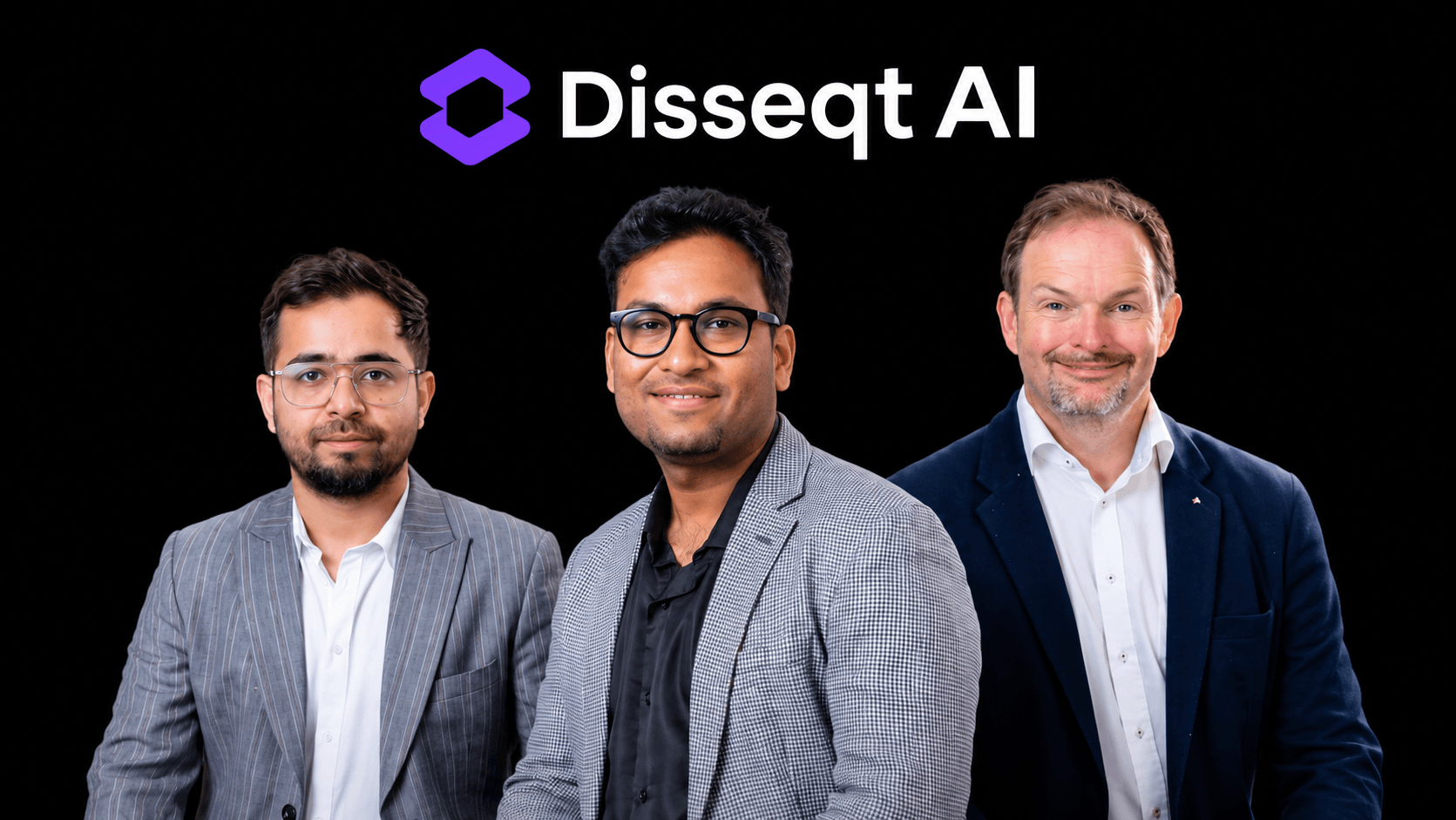
Founded in late 2025 by Apoorva Kumar, Manish Atri and Cyril Treacy, Disseqt builds technology to test, monitor and govern enterprise AI applications and agents.
The company wants to become an independent assurance layer between AI agents and the organisations that deploy them.
Apoorva Kumar Wants Enterprises to Prove Their AI Is Safe
Disseqt's CEO and co-founder Apoorva Kumar believes that AI adoption is being held back by a gap between what agents can do and what companies can verify.
"Every enterprise is handing real work to AI agents, but very few can prove those agents are safe, fair and within policy," Kumar said in the funding announcement.
That is the problem Disseqt is attempting to solve.
Its platform works across three stages of an AI application's lifecycle:
Before deployment: Tests AI applications and agents for vulnerabilities, unsafe responses, bias and privacy risks.
During operation: Enforces company policies and can block outputs that violate those policies.
Continuous monitoring: Tracks behaviour, detects changes and maintains evidence for audits and oversight.
The platform is designed to work independently of the model providers, allowing organisations to apply their own assurance controls even when they use different underlying AI models.
This distinction is important for enterprises that rely on multiple AI systems and need consistent governance across their technology stack.
From 80% to 99%: A Real-World Example
Disseqt says its assurance technology has already been used in demanding enterprise environments.
In one project involving a global sports league's fan-engagement agent, which serves approximately 80 million fans, the company reports that it improved the safe-response rate from 80% to 99%.
The testing covered safety, bias and privacy risks. According to Disseqt, after the identified issues were addressed, the original failing tests produced no unsafe outputs when repeated.
The company also reports providing assurance for a large European bank's credit-card services programme.
These results are company-reported, but they illustrate the type of risk Disseqt is targeting: AI applications that interact with large customer populations or handle sensitive financial information cannot rely on informal testing alone.
Why Rahul Dravid and Enterprise Investors Are Backing the Company
The investor mix is notable.
Alongside institutional investors Gresham House Ventures, Sure Valley Ventures, Delta Partners and Enterprise Ireland, the round includes angel investors from major technology companies.
Rahul Dravid also participated as an individual angel investor.
For Gresham House Ventures, the investment reflects a belief that AI governance and assurance will become essential infrastructure as businesses move agents into live operations.
Its partner Rohit Mathur said enterprises need tools that can test and control AI independently of the model providers they use.
This is particularly relevant in sectors such as banking, insurance and public services, where AI systems may handle sensitive information and customer-facing decisions.
What the $8 Million Will Help Disseqt Build Next
The company plans to use the funding to expand its enterprise customer base and grow internationally.
It is hiring across sales, operations and technology, with a significant focus on its India team. It also plans to strengthen its presence in London and use the UK market to reach more enterprise customers.
The long-term ambition is to make AI assurance a standard part of how companies deploy and manage every AI agent.
Disseqt's challenge will be to demonstrate that its technology can work reliably across different models, business systems and regulatory environments.
The Bigger Picture: AI Governance Is Becoming Infrastructure
The AI industry has spent years improving model capabilities. But as agents gain access to business systems and begin taking actions, organisations need more than intelligence.
They need visibility into what an agent is doing, controls over what it is allowed to do and evidence that it follows the organisation's policies.
This creates an opportunity for companies building the infrastructure around AI, not just the models themselves.
Disseqt is positioning itself in that layer. Its $8 million funding gives the founders resources to expand the technology and reach more enterprise customers.
The bottom line: The next phase of enterprise AI will not be judged only by how capable agents become. Businesses will also need to prove that those agents can be trusted. Disseqt is betting that testing, monitoring and governance will become essential infrastructure for that future.