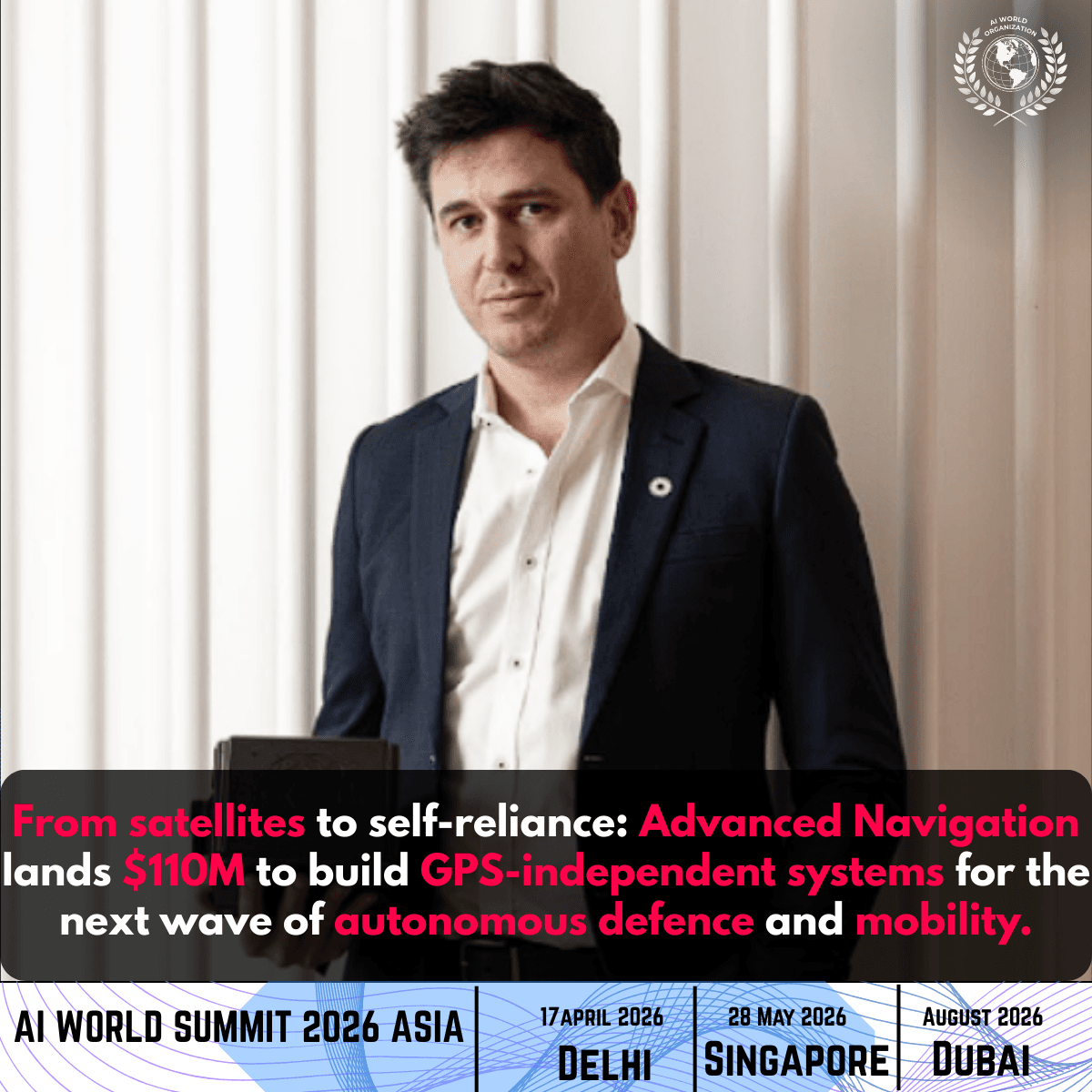
Advanced Navigation Raises $110M to Go Beyond GPS
Advanced Navigation secures $110M Series C to build AI-powered, GPS-independent navigation systems for autonomous defence and commercial use globally.
TL;DR
Australian navigation tech firm Advanced Navigation has raised $110M in a Series C round led by Airtree Ventures, with backing from Quadrant Private Equity and Australia's NRFC. The funds will drive global expansion and development of AI-powered, GPS-independent navigation systems built for defence, maritime, and autonomous platforms operating in GPS-denied environments.
Advanced Navigation Secures $110M Series C to Power the Next Era of GPS-Independent Autonomous Systems
The global navigation landscape is undergoing one of its most consequential transformations in decades — and a single landmark deal is accelerating that change at full throttle. Advanced Navigation, a globally recognised leader in autonomous systems and navigation technology, has officially closed a US$110 million (AU$158 million) Series C funding round, marking a defining milestone not just for the company, but for the entire ecosystem of AI-powered autonomous mobility. As discussions around AI funding continue to dominate boardrooms and defence corridors alike, this raise stands out as one of the most strategically significant AI funding news stories of 2026 — one that carries deep implications for global defence resilience, autonomous transportation, and the future of sovereign technology infrastructure.
The round was led by Airtree Ventures, with pivotal strategic participation from Quadrant Private Equity and the National Reconstruction Fund Corporation (NRFC) — an Australian government-backed entity that focuses on building and maintaining critical industrial capabilities domestically. These new entrants join an already formidable group of existing investors, including Main Sequence, KKR, In-Q-Tel, Alpha Intelligence Capital, The Hon. Malcolm Turnbull AC, and OIF Ventures, forming one of the most high-profile and strategically diverse investor coalitions in the deep technology space. The scale of this raise speaks volumes about where institutional money is flowing in 2026 — and navigating beyond GPS is clearly at the top of that list.
Why the World Can No Longer Afford to Depend on GPS Alone
For decades, GPS has functioned as the invisible backbone of modern civilisation. From guiding aircraft and naval vessels to enabling precision agriculture, autonomous delivery drones, and military targeting systems, global positioning infrastructure has been treated as an immovable constant — a reliable utility that simply works. But that assumption is crumbling. What was once treated as a dependable, always-on technology has been revealed for what it truly is: a fragile, single-point-of-failure system operating in an increasingly hostile electromagnetic environment.
The threat landscape has shifted dramatically in recent years. Electronic warfare capabilities have proliferated across state and non-state actors alike, and GPS jamming and spoofing incidents — once confined to military theatres — are now occurring with alarming frequency in commercial airspace, maritime corridors, and urban environments. According to publicly available defence intelligence, over 10,000 GPS disruption events were recorded in contested regions globally between 2022 and 2025 alone. For autonomous systems operating in these environments — whether they are unmanned aerial vehicles delivering humanitarian supplies, naval frigates navigating contested waters, or self-driving logistics platforms crossing national borders — a momentary GPS outage is not an inconvenience. It is a mission-ending, potentially life-threatening failure.
This is the systemic vulnerability that Advanced Navigation has built its entire business around solving. Chris Shaw, the company's CEO and co-founder, put it with striking clarity: "The era of relying on a single silver bullet for navigation is over. Across defence, energy transition, humanitarian response, and autonomous missions, certainty is required where GPS can no longer be trusted." That conviction, backed now by $110 million in fresh capital, is what positions Advanced Navigation not merely as a participant in the GPS-alternative market — but as its defining force.
The timing of this AI funding round is equally deliberate. Governments across the United States, Europe, and the Indo-Pacific are accelerating investments in sovereign navigation capabilities, explicitly recognising that over-reliance on GPS — a system originally designed and controlled by the US military — creates strategic dependencies that adversaries can exploit. This Series C positions Advanced Navigation directly at the intersection of national security priorities and commercial-scale autonomous systems, a space that is rapidly attracting the world's most serious capital.
The Technology at the Core: AdNav Intelligence and Multi-Sensor Fusion
At the heart of Advanced Navigation's solution is a philosophy that marks a genuine departure from how navigation has traditionally been approached: rather than searching for a single better replacement to GPS, the company has engineered a layered, multi-sensor architecture that fuses data from multiple complementary technologies simultaneously, in real time, with onboard intelligence making continuous micro-adjustments based on mission context. This is not incremental improvement — it is a fundamental architectural rethink.
The proprietary software engine powering this approach is called AdNav Intelligence (AI) — a fitting name for a platform that quite literally puts artificial intelligence at the centre of navigation. AdNav Intelligence operates as a continuous fusion engine, drawing from high-precision inertial sensors, acoustic positioning systems, photonic and quantum sensing hardware, visual odometry, and GNSS receivers (when available), cross-validating all data streams in real time to produce a navigation output of exceptional reliability and precision. The result is a system that does not degrade gracefully when GPS fails — it continues operating at full mission-capability, adapting its sensor weighting dynamically based on which inputs are available and which are compromised.
The company's hardware heritage runs deep across robotics, inertial navigation, underwater acoustics, quantum sensing, and AI-enhanced GNSS receivers — a vertically integrated capability stack that very few companies in the world can credibly replicate. This is not a software startup bolting AI onto commodity sensors; Advanced Navigation manufactures its own high-precision hardware in Australia, allowing it to optimise the full stack from silicon to system output. That level of vertical integration is a significant competitive moat in an industry where supply chain reliability and sovereign manufacturing are becoming as strategically important as the technology itself.
The implications of this architecture stretch across every domain of autonomous operations. In the defence sector, it means armoured vehicles, counter-drone systems, mobile radar platforms, and air defence installations can continue to navigate and operate with full precision in GPS-jammed or spoofed environments. In the commercial sector, it means autonomous surface vessels can traverse international waters without GPS dependency, autonomous mining vehicles can operate reliably in deep underground environments, and next-generation delivery drones can maintain precise positioning over urban areas even when GPS signals are intentionally disrupted. The breadth of addressable use cases is one of the reasons this AI funding round drew participation from such a diverse investor group.
Global Expansion: Building PNT Centres of Excellence Across Priority Markets
With this substantial capital raise now closed, Advanced Navigation has set out a clear, ambitious roadmap for global expansion — one that goes well beyond simply hiring more engineers or opening additional offices. The company's strategic vision centres on establishing PNT Centres of Excellence in key markets, beginning with the United States and Europe, where more than 80% of its revenue is already generated.
More than 100,000 Advanced Navigation systems have already been deployed across global militaries, research organisations, maritime operators, and industrial enterprises. That installed base is remarkable, but it also tells a more important story: the demand for GPS-alternative PNT solutions is not theoretical. It exists at scale, right now, and it is growing faster than available supply. The Centres of Excellence are designed specifically to close that gap — by embedding highly specialised engineering teams directly within priority regions, co-developing bespoke solutions with local defence and commercial partners, and anchoring the long-term trusted-supplier relationships that national governments increasingly require when procuring mission-critical infrastructure.
Louis Casey, Partner at Quadrant Private Equity, framed the investment in terms of Advanced Navigation's role at the frontier of its industry: "Advanced Navigation is at the forefront of autonomous systems for resilient navigation, pioneering solutions that redefine precision and reliability in defence and commercial applications." That language — resilience, precision, frontier — reflects not just Quadrant's thesis on Advanced Navigation specifically, but the broader conviction across the investment community that GPS-alternative navigation is transitioning from a niche defence capability into a fundamental requirement across every autonomous system category.
Beyond establishing regional centres, the company has also signalled its intent to pursue targeted acquisitions in adjacent deep technology domains, including robotics, photonics, computer vision, quantum sensing, and advanced AI. These are not peripheral adjacencies — they are the precise technologies that the next generation of navigation architecture will be built on. By acquiring or deepening capabilities in these areas, Advanced Navigation is not just expanding its product portfolio; it is building an integrated technology platform capable of addressing navigation challenges that do not yet have commercially viable solutions. For the global AI funding ecosystem watching this space, it is a clear signal that deep tech autonomy is entering a phase of aggressive consolidation and capability-building.
Australia's Sovereign Technology Ambitions on the World Stage
One of the most significant dimensions of this Series C round — and one that sets it apart from many other high-profile AI funding news stories — is its explicit sovereign industrial policy dimension. The participation of the National Reconstruction Fund Corporation (NRFC), a body established by the Australian federal government to rebuild domestic industrial capabilities in critical sectors, signals that Advanced Navigation is being treated as genuine national strategic infrastructure.
David Gall, CEO of the NRFC, was explicit about the intent behind the investment: "NRFC investment in Advanced Navigation will keep the company's headquarters, core R&D, and high-precision manufacturing capabilities here in Australia, building our sovereign and defensive capabilities and paving the way for the navigational tools of the future." This is not a passive financial return play. The NRFC is backing Advanced Navigation because it represents a rare and valuable combination: a commercially successful, globally competitive deep technology business whose core intellectual property and manufacturing capabilities remain in Australian hands.
That matters enormously in the current geopolitical climate. As the United States, the European Union, and the Indo-Pacific democracies collectively move toward supply-chain sovereignty and technology decoupling from adversarial states, the ability to design, manufacture, and export high-precision navigation systems from a stable, allied jurisdiction is an asset of genuine strategic value. Advanced Navigation's positioning as an Australian-headquartered company with a global commercial footprint means it can serve as a trusted supplier to all major Western allied defence ecosystems without triggering the technology-export sensitivities that affect vendors domiciled in more contested regulatory environments.
Furthermore, the company's manufacturing expansion plans will generate substantial high-skill employment in Australia — in STEM fields, advanced manufacturing, and precision engineering — areas that the country has historically struggled to retain talent in due to competition from larger offshore technology hubs. The ripple effects of this investment, measured in terms of knowledge creation, industrial capability building, and long-term economic value, extend well beyond the balance sheet of a single funding round.
What This Means for the Future of Autonomous Systems and AI-Powered Navigation
Stepping back from the details of this specific deal, it is worth appreciating the broader arc of technological change that Advanced Navigation's Series C funding represents. The intersection of artificial intelligence and navigation is producing a generation of autonomous systems that were simply not possible five years ago — systems that can sense, adapt, reason, and act in environments where the conventional infrastructure of the digital world either does not reach or cannot be trusted.
Advanced Navigation's AdNav Intelligence engine is a working example of what happens when AI is not applied as a feature layer on top of existing hardware, but is instead designed into the core architecture of a mission-critical system from the ground up. By treating navigation as a continuous, intelligent inference problem rather than a deterministic calculation problem, the company is effectively reimagining what a navigation system fundamentally is. It is less a GPS replacement and more an intelligent situational awareness platform that happens to produce position, velocity, and timing outputs of extraordinary precision under any conditions.
The broader AI funding ecosystem has clearly taken notice. With AI funding news in the autonomy and defence sectors accelerating dramatically through 2025 and into 2026, Advanced Navigation's $110 million raise is one of the clearest indicators that serious institutional capital is now flowing toward companies that can bridge the gap between laboratory-grade AI capabilities and real-world operational deployment in contested, high-stakes environments. The fact that this raise brought together venture capital, private equity, sovereign wealth instruments, and strategic intelligence community investors in a single coalition speaks to the multi-dimensional value that genuinely disruptive navigation technology represents in the current era.
As autonomous vehicles scale from controlled environments into genuinely contested and unpredictable frontiers — whether they are traversing war zones, exploring ocean floors, navigating polar supply routes, or operating in spectrum-denied urban corridors — the demand for what Advanced Navigation builds will only deepen. The $110 million Series C is not an endpoint. It is a launchpad.